
- Empty cart.
- Continue Shopping
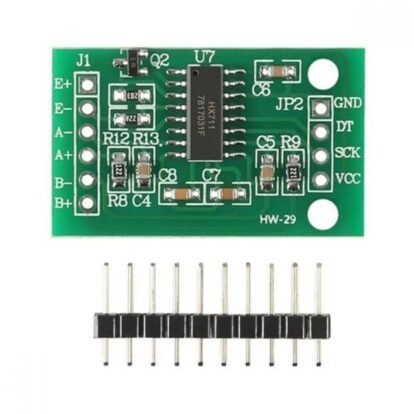
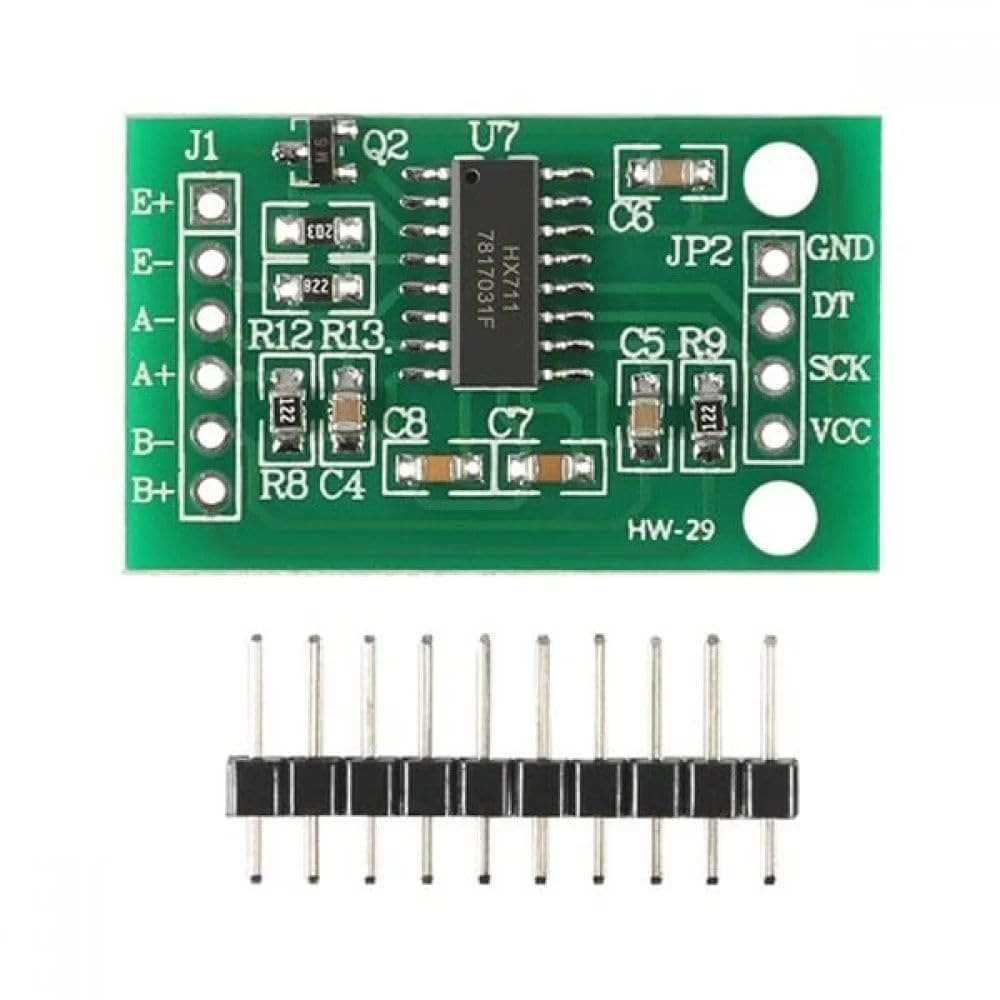
HW-29 Load Cell Amplifier Module
₹197.00Current price is: ₹197.00. Original price was: ₹232.00.
1 in stock (can be backordered)
Add to cart
Buy Now

HW-29 Load Cell Amplifier Module: Precision Signal Conditioning for Weight Sensors
Achieve unparalleled measurement accuracy in your electronic weighing systems with the high-performance HW-29 Load Cell Amplifier Module. Engineered specifically for engineers, makers, and industrial developers, this compact breakout board bridges the gap between fragile analog weight sensors and digital microcontrollers. Whether you are assembling a highly precise digital laboratory scale, a commercial kitchen sensor matrix, or an industrial smart traffic infrastructure setup, this robust module provides the ultra-stable signal amplification required to ensure consistent, reliable data.
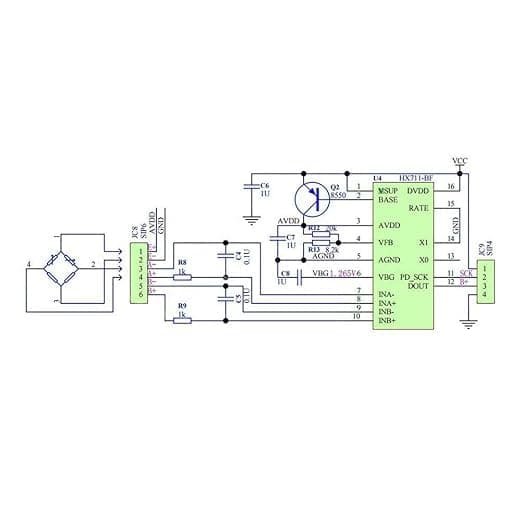
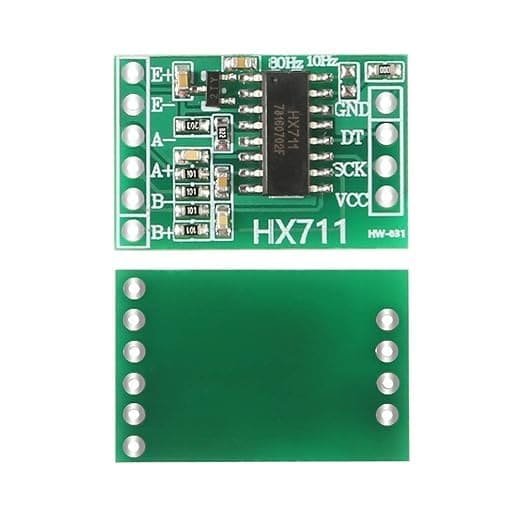
At the absolute center of this communication board is the industry-standard HX711 chip. Standard microcontrollers lack the analog-to-digital resolution necessary to read the micro-volt changes generated by traditional strain gauge load cells. The HW-29 Load Cell Amplifier Module solves this limitation by incorporating an integrated, high-precision 24-bit analog-to-digital converter (ADC) designed exclusively for weigh scale applications. By processing signal gains internally, the module frees up processing overhead on your main hardware architecture, minimizing software bottlenecks and streamlining sensor throughput.
Key Features of the HX711 Weighing Sensor Board
When deploying electronic components into automated testing or commercial settings, precision and reliability are non-negotiable. The HW-29 Load Cell Amplifier Module stands out due to its feature-rich, ruggedly stable architecture:
Dual-Channel Input Selection: Features an internal active low-noise programmable gain amplifier (PGA) with selectable gains of 32, 64, or 128 for channel A, plus an independent channel B with a fixed gain of 32.
High-Resolution 24-Bit ADC: Utilizes an authentic HX711 chip to deliver exceptionally smooth, granular weight variations without fluctuating readouts.
Onboard Power Supply Regulator: Includes an integrated low-noise regulator dedicated entirely to powering the external load cell and the internal analog circuitry, eliminating electrical noise interference.
Simple Digital Control Interface: Uses a streamlined, 2-wire serial protocol (Clock and Data lines) that does not require complex programming or dedicated hardware SPI ports.
Fast Output Data Rates: Supports user-selectable output data rates of either 10 samples per second (SPS) for ultra-stable laboratory readings or 80 SPS for rapid-response dynamic applications.
Pin Configuration and Hardware Interfacing
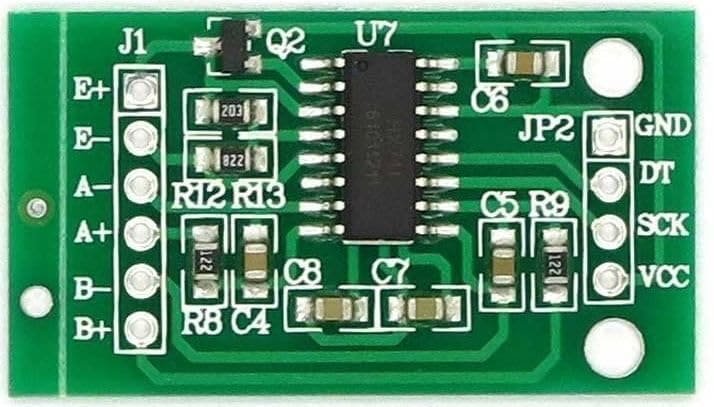
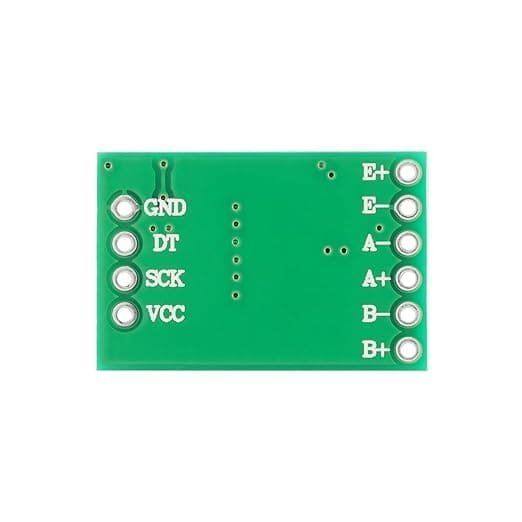
Connecting the HW-29 Load Cell Amplifier Module to both your weighing hardware and your master processing unit is incredibly straightforward. The compact green PCB features clearly labeled connection pads split into two distinct functional zones.
Load Cell Input Side (Analog Connections):
E+ (Excitation Positive): Supplies the positive operating voltage to the strain gauge bridge.
E- (Excitation Negative): Serves as the ground return line for the load cell bridge power.
A- (Channel A Negative Input): Receives the negative analog differential signal from the sensor.
A+ (Channel A Positive Input): Receives the positive analog differential signal from the sensor.
B- / B+ (Channel B Inputs): Secondary auxiliary differential inputs for multi-sensor scaling or dual-bridge monitoring layouts.
Microcontroller Output Side (Digital Interface Header JP2):
VCC: Power input line, fully compatible with standard 2.6V to 5.5V DC systems.
DT (Data Output): Serial data line that sends processed 24-bit conversion packets straight to your controller.
SCK (Serial Clock Input): Synchronizes data transfer streams from the host microcontroller.
GND: System ground connection.
Universal Microcontroller Compatibility
No matter what ecosystem your smart project operates on, the HW-29 Load Cell Amplifier Module serves as a universal translator for analog weight data. It integrates seamlessly with today’s leading prototyping and production platforms:
Ideal for Arduino Scales
Transform a basic Arduino Uno, Nano, or Mega into an industrial-grade weighing machine. Utilizing widely available, open-source HX711 libraries, you can calibrate your scale, establish a tare weight function, and print accurate mass readings to an LCD or serial monitor with very minimal configuration.
High-Speed Telemetry with ESP32 & NodeMCU
When building Internet of Things (IoT) connected smart systems, combining the HW-29 module with an ESP32 or ESP8266 gives your hardware immediate wireless capabilities. Stream live inventory weights, industrial tank levels, or agricultural feed metrics straight to secure cloud databases, local dashboards, or mobile monitoring applications.
Industrial PLC & Raspberry Pi Pico Deployments
For custom industrial automation panels or advanced dual-core computing applications, the low-profile design of this module provides an exceptional physical layer to link structural load cells directly to modern ARM-based microcontrollers.
Versatile Applications across Industries
The rugged flexibility of the HW-29 Load Cell Amplifier Module makes it a vital tool for an extensive array of commercial, hobbyist, and industrial environments:
Smart Inventory Management: Build automated storage racks that track real-time stock levels dynamically by constantly calculating overall bin weights.
Industrial Force Testing: Design custom tension, compression, and structural material strain testing equipment with high-resolution logging.
Automated Filling Machinery: Create smart packaging or liquid dispensing stations that cut off supply valves instantly when a precise targeted weight threshold is met.
DIY Smart Appliances: Build customized digital bathroom scales, electronic kitchen meters, or interactive luggage balances.
Technical Specifications
Core Chipset: Authentic HX711 High-Precision 24-Bit Analog-to-Digital Converter
Operating Voltage Range: 2.6V to 5.5V DC
Operation Current: Less than 1.5mA during active sensing (Less than 1µA in standby power-down mode)
Selectable Data Rate: 10 Hz or 80 Hz output sampling options
Operating Temperature Spectrum: Engineered to function flawlessly from -40°C to +85°C
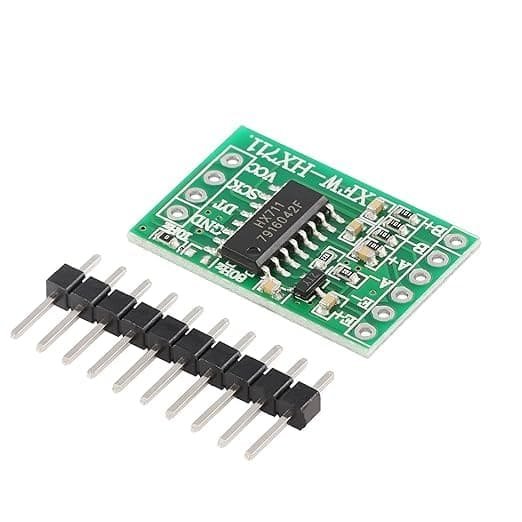
Form Factor: Ultra-lightweight, compact PCB footprint with heavy-duty header pins included for seamless breadboard prototyping or permanent solder arrays.
| Weight | 0.5 kg |
|---|---|
| Dimensions | 5.0 × 3.5 × 1.5 cm |

Reviews
There are no reviews yet.