
- Empty cart.
- Continue Shopping
Industrial Sensor False Detection: 7 Hidden Costs That Hurt Productivity
- Posted on
 Deepak Joshi
- 0
- Categories: Industrial Automation

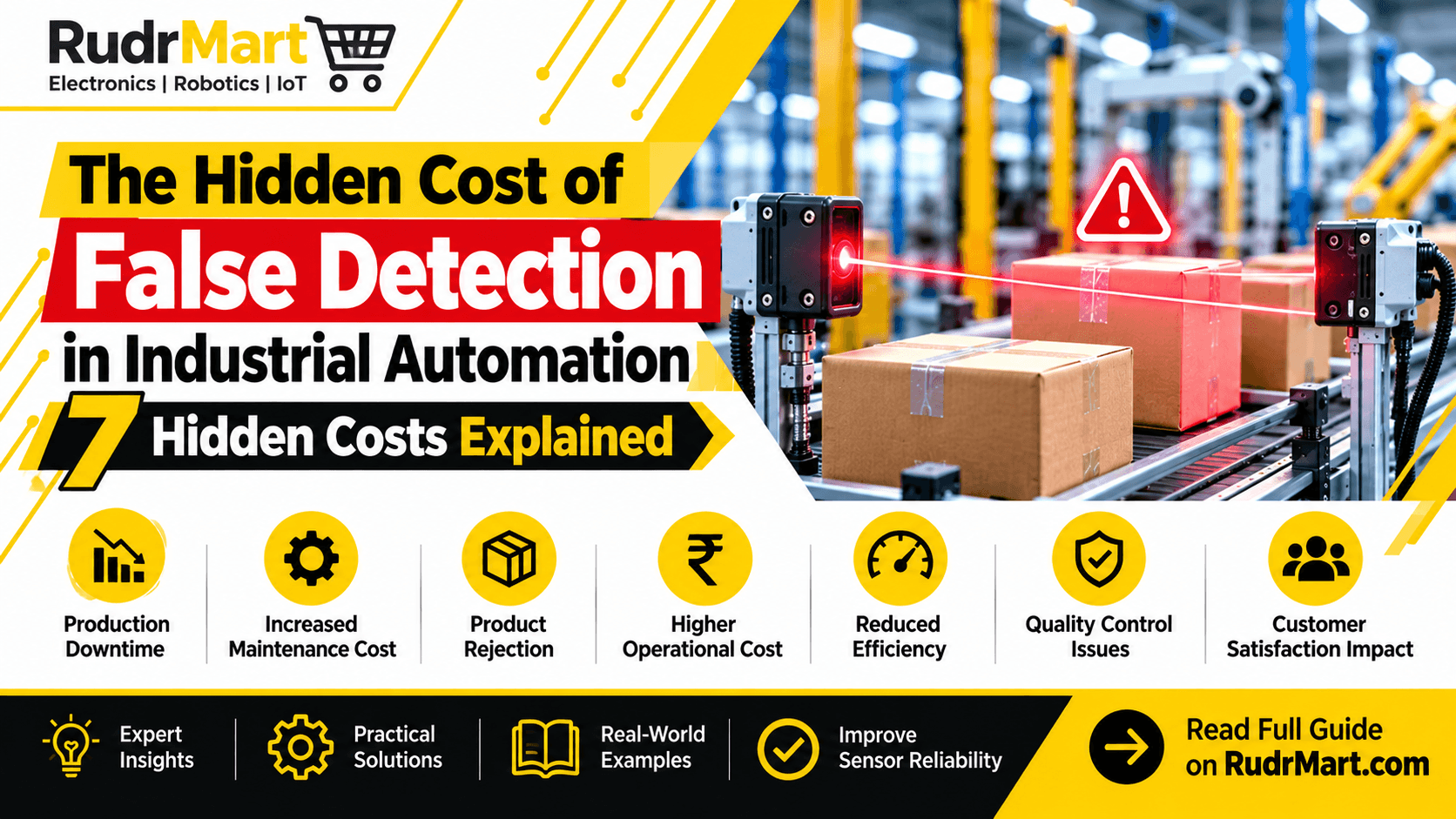
Industrial Sensor False Detection is one of the most overlooked operational problems in modern manufacturing. A sensor may appear to be a small component in an automated production line, but an incorrect detection signal can trigger unnecessary machine stops, rejected products, inaccurate counting, and expensive troubleshooting.
As factories increasingly depend on automated inspection, packaging, material handling, and conveyor systems, reliable object detection has become essential.
A single false signal may seem insignificant. However, when repeated throughout a production shift, these errors can affect productivity, equipment efficiency, maintenance expenses, and customer satisfaction.
In this article, we explore seven hidden costs of industrial sensor false detection, common causes, and practical strategies businesses can use to improve detection reliability.
Table of Contents
- What Is Industrial Sensor False Detection?
- Why False Detection Happens in Automated Factories
- 7 Hidden Costs of Industrial Sensor False Detection
- How False Detection Affects Different Industries
- How to Reduce Industrial Sensor False Detection
- Why Sensor Reliability Matters More Than Purchase Price
- Industrial Sensor Solutions Available at Rudr Mart
- The Future of Reliable Industrial Detection
- Frequently Asked Questions
- Conclusion
What Is Industrial Sensor False Detection?
Industrial sensor false detection occurs when a sensing system incorrectly identifies the presence or absence of an object, movement, or physical condition.
Two common situations are:
False positive: A sensor reports that an object is present when it is not.
False negative: A sensor fails to detect an object that is actually present.
Both can disrupt automated processes.
For example, a photoelectric sensor on a packaging conveyor may incorrectly signal that a carton has arrived. The machine might activate a labeling mechanism even though the carton is missing.
Alternatively, the sensor might fail to detect an actual carton, causing it to pass through the line without the intended operation.
These errors are especially problematic when equipment operates continuously at high production speeds.
Why Does Industrial Sensor False Detection Happen?
Several environmental, electrical, mechanical, and application-related factors can affect industrial sensor reliability.
Dust, Dirt, and Contamination
Manufacturing environments often contain dust, oil mist, moisture, and other contaminants.
When these accumulate on optical sensing surfaces, they may reduce signal strength or interfere with object detection.
Incorrect Sensor Alignment
Photoelectric sensors require appropriate positioning and alignment.
Vibration, accidental impact, or loose mounting brackets can change the detection angle and cause intermittent operation.
Electrical Interference
Industrial equipment such as motors, variable-frequency drives, and switching devices can introduce electrical interference.
Improper cable routing, grounding, or shielding may increase the risk of unreliable signals.
Reflective or Transparent Materials
Shiny metal, transparent plastic, glass, and reflective packaging can be challenging for certain optical sensing methods.
The appropriate sensing technology depends on the target material and application.
Incorrect Sensitivity Settings
A sensor configured with unsuitable sensitivity or detection thresholds may respond to background objects or fail to recognize the intended target.
According to OMRON’s photoelectric sensor precautions, alignment, contamination, ambient light, and operating conditions are important considerations for reliable detection.
7 Hidden Costs of Industrial Sensor False Detection
The consequences of unreliable detection extend beyond the cost of replacing a sensor.
1. Unexpected Production Downtime
Production downtime is one of the most immediate consequences of industrial sensor false detection.
When a sensor sends an incorrect signal, automated equipment may stop, pause, or enter a fault condition.
Operators must investigate the issue before normal production resumes.
Repeated interruptions can reduce overall equipment effectiveness (OEE), particularly on high-volume manufacturing lines.
Example:
Consider a production line that experiences six false-trigger interruptions per shift, each requiring three minutes to investigate and restart.
That represents 18 minutes of lost production time per shift.
Across 25 working days, the same problem could result in 7.5 hours of avoidable downtime.
This is an illustrative calculation, not an industry-average downtime estimate.
2. Increased Product Rejection and Material Waste
Incorrect detection can interfere with sorting, counting, filling, labeling, and packaging operations.
A false trigger might activate equipment at the wrong moment, while a missed detection may allow a product to bypass a required process.
Potential consequences include:
- Incorrect product sorting
- Missing or misplaced labels
- Packaging defects
- Rejected manufactured components
- Additional material consumption
The financial impact depends on the product value, process design, and availability of downstream quality checks.
3. Higher Maintenance and Troubleshooting Expenses
Intermittent sensor faults can be difficult to diagnose because they may disappear during inspection.
Maintenance teams might spend considerable time checking cables, controllers, mounting brackets, electrical connections, and sensor settings.
When the underlying cause remains unidentified, repeated service visits can increase maintenance costs.
Industrial sensor false detection may also lead to unnecessary component replacement when the actual problem is contamination, misalignment, or electrical interference.
A structured maintenance approach helps distinguish genuine hardware failure from installation-related problems.
4. Reduced Production Efficiency
Even when false detections do not completely stop production, they may slow operations.
Operators may reduce conveyor speed, introduce manual checks, or increase inspection frequency to compensate for unreliable signals.
These temporary measures can lower throughput and reduce the benefits of automation.
For factories investing in high-speed production equipment, inconsistent detection can prevent machinery from achieving its intended operating performance.
5. Increased Labour and Operational Costs
Automation is designed to reduce repetitive manual intervention.
However, unreliable sensing can require additional supervision and troubleshooting.
Workers may need to monitor equipment continuously, manually confirm object detection, or remove incorrectly processed products.
Over time, these activities consume resources that could otherwise support production, maintenance improvement, or quality management.
6. Quality Control and Customer Satisfaction Problems
Reliable sensing plays an important role in maintaining consistent manufacturing quality.
If a defective product escapes detection or a correctly manufactured product is unnecessarily rejected, the consequences can extend beyond the factory.
Possible outcomes include additional inspection, rework, delayed shipments, customer complaints, and increased warranty-related expenses.
For manufacturers supplying components under strict quality requirements, consistent detection performance is particularly important.
7. Higher Long-Term Equipment Ownership Costs
The initial purchase price of a sensor represents only one part of its total ownership cost.
Other factors include installation, calibration or adjustment, cleaning, troubleshooting, replacement, production interruption, and maintenance labour.
A low-cost sensor that performs inconsistently in a demanding environment may create higher operational expenses than a more suitable sensor with a higher initial purchase price.
Therefore, sensor purchasing decisions should consider long-term application performance rather than price alone.
How False Detection Affects Different Industries
Industrial sensor false detection can affect many manufacturing and material-handling operations.
| Industry | Potential detection problem | Business impact |
|---|---|---|
| Food and beverage | Missed bottle or package detection | Rejection and packaging waste |
| Automotive | Incorrect component presence signal | Assembly interruption |
| Pharmaceuticals | Incorrect carton or container detection | Additional inspection and rework |
| Logistics | Inaccurate parcel detection | Sorting delays |
| Electronics manufacturing | Missed component detection | Quality-control issues |
| Packaging | False carton positioning signal | Incorrect labeling or machine stoppage |
The severity of each problem depends on the process and the controls installed to detect and manage errors.
How to Reduce Industrial Sensor False Detection
Reducing false detections requires attention to sensor suitability, installation quality, operating conditions, and preventive maintenance.
Select the Right Sensing Technology
Different detection methods are suitable for different applications.
Through-beam, retro-reflective, diffuse-reflective, and other sensing technologies have different strengths and limitations.
Evaluate the target object’s size, material, colour, surface finish, detection distance, and movement speed before selecting a sensor.
Maintain Proper Alignment
Sensor mounting should be mechanically stable.
Inspect mounting brackets and verify optical alignment after equipment maintenance, accidental impact, or production-line modifications.
Protect Sensors from Contamination
Regular cleaning can help prevent dust and dirt from interfering with optical detection.
Cleaning methods must follow the manufacturer’s instructions to avoid damaging lenses or housings.
Improve Electrical Installation
Check power-supply stability, cable condition, grounding, shielding, and routing near electrically noisy equipment.
Electrical interference should be investigated systematically rather than assuming every false trigger is caused by a defective sensor.
Monitor Detection Performance
Where supported by the equipment, monitor sensor status, fault events, and signal stability.
Recording recurring errors can help maintenance teams identify patterns linked to particular shifts, operating conditions, or machinery.
Use Appropriate Signal Filtering
For suitable non-safety applications, properly engineered debounce or filtering logic may help reject brief unwanted transitions.
However, filtering must not hide genuine faults or delay required responses. Safety-related sensing functions require appropriate safety-rated equipment and validated control systems.
Why Sensor Reliability Matters More Than Purchase Price
The cheapest sensor is not necessarily the most economical option for an industrial operation.
Consider a hypothetical factory where repeated false detections cause 30 minutes of downtime each month.
If the estimated production contribution lost during downtime is ₹4,000 per hour, the annual downtime impact would be:
0.5 hours × 12 months × ₹4,000 = ₹24,000
This example excludes maintenance labour, rejected products, and other indirect expenses.
It illustrates why businesses should evaluate the total operational impact of detection problems.
A better purchasing approach considers:
- Application suitability and detection reliability
- Environmental resistance
- Electrical and controller compatibility
- Installation and maintenance requirements
- Manufacturer documentation and technical support
- Total cost of ownership
A correctly selected and installed sensor can support more consistent production performance.
Industrial Sensor Solutions Available at Rudr Mart
Businesses and automation professionals looking for industrial detection components can explore the sensor products available at Rudr Mart.
OPTEX Z2T-2000P Through-Beam Sensor
The OPTEX Z2T-2000P is listed as a 25-metre, PNP-output through-beam sensor.
Through-beam sensing uses separate emitting and receiving units. An object is detected when it interrupts the optical beam.
This sensing principle can be useful for object-presence applications where the installation geometry and environmental conditions are suitable.
Fotex A3R 4mx Sensor
The Fotex A3R 4mx is another industrial sensor listed on Rudr Mart.
Before purchasing, buyers should confirm its sensing principle, required detection range, output type, supply voltage, environmental rating, and compatibility with their equipment.
Neither product should be assumed to eliminate false detections in every environment. Actual performance depends on application requirements and correct installation.
Explore more: Industrial Sensors and Modules at Rudr Mart.
For additional background on sensor output technologies, read our existing article: Analog vs Digital Sensors: What’s the Difference?.
The Future of Reliable Industrial Detection
Modern industrial automation is increasingly incorporating sensor diagnostics, connected monitoring, and condition-based maintenance.
These technologies can help identify changing operating conditions before they lead to repeated equipment interruptions.
For example, some advanced photoelectric sensors can monitor signal stability and provide diagnostic information related to contamination or alignment.
Manufacturers may also combine detection data with machine-performance records to investigate recurring faults.
However, digital monitoring cannot replace correct sensor selection, sound installation practices, and regular maintenance.
The future of reliable industrial detection depends on combining suitable hardware with effective operational processes.
Frequently Asked Questions
1. What is industrial sensor false detection?
Industrial sensor false detection occurs when a sensor incorrectly reports that an object or condition is present or absent. It may result in unnecessary machine actions, missed detections, or production interruptions.
2. What causes false triggering in photoelectric sensors?
Common causes include incorrect alignment, dust, reflective surfaces, ambient light, electrical interference, unstable mounting, and unsuitable sensitivity settings.
3. Can industrial sensor false detection increase manufacturing costs?
Yes. Depending on the application, repeated detection errors can contribute to downtime, rejected products, troubleshooting expenses, and reduced production efficiency.
4. How can factories reduce false sensor signals?
Factories can improve reliability through appropriate sensor selection, stable mounting, correct alignment, environmental protection, electrical installation checks, and preventive maintenance.
5. Are expensive industrial sensors always more reliable?
No. Higher price does not automatically guarantee better performance. Reliability depends on whether the sensor is suitable for the actual operating environment and detection requirements.
6. Which sensors are commonly used for object detection?
Photoelectric sensors, inductive proximity sensors, capacitive sensors, and other industrial detection technologies are used depending on the target material and application.
7. Where can businesses buy industrial sensors in India?
Businesses can explore industrial sensing products through suppliers such as Rudr Mart. Before ordering, confirm product specifications, compatibility, and current availability.
Conclusion
Industrial Sensor False Detection is more than a minor technical inconvenience. Repeated false signals can affect production uptime, product quality, maintenance expenditure, labour efficiency, and overall manufacturing performance.
The most effective response is not simply to replace sensors whenever a fault occurs. Businesses should investigate the actual cause, evaluate application requirements, improve installation quality, and adopt appropriate maintenance practices.
Reliable sensing supports more consistent automation, fewer unnecessary interruptions, and better long-term operational efficiency.
Looking for industrial sensing components? Explore the Rudr Mart sensor collection and review the available options for your automation requirements.
False TriggeringIndustrial AutomationIndustrial Sensor False DetectionIndustrial SensorsManufacturing EfficiencyPhotoelectric SensorsProduction DowntimeSensor Reliability