
- Empty cart.
- Continue Shopping
SG90 vs MG995 Servo Motor: 7 Best Differences Explained for Arduino & Robotics
- Posted on
 Deepak Joshi
- 0
- Categories: Electronics, Robotics & IoT

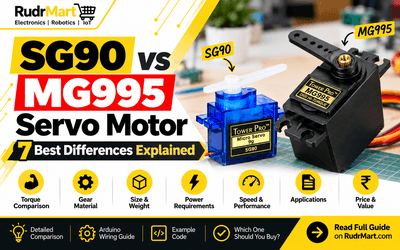
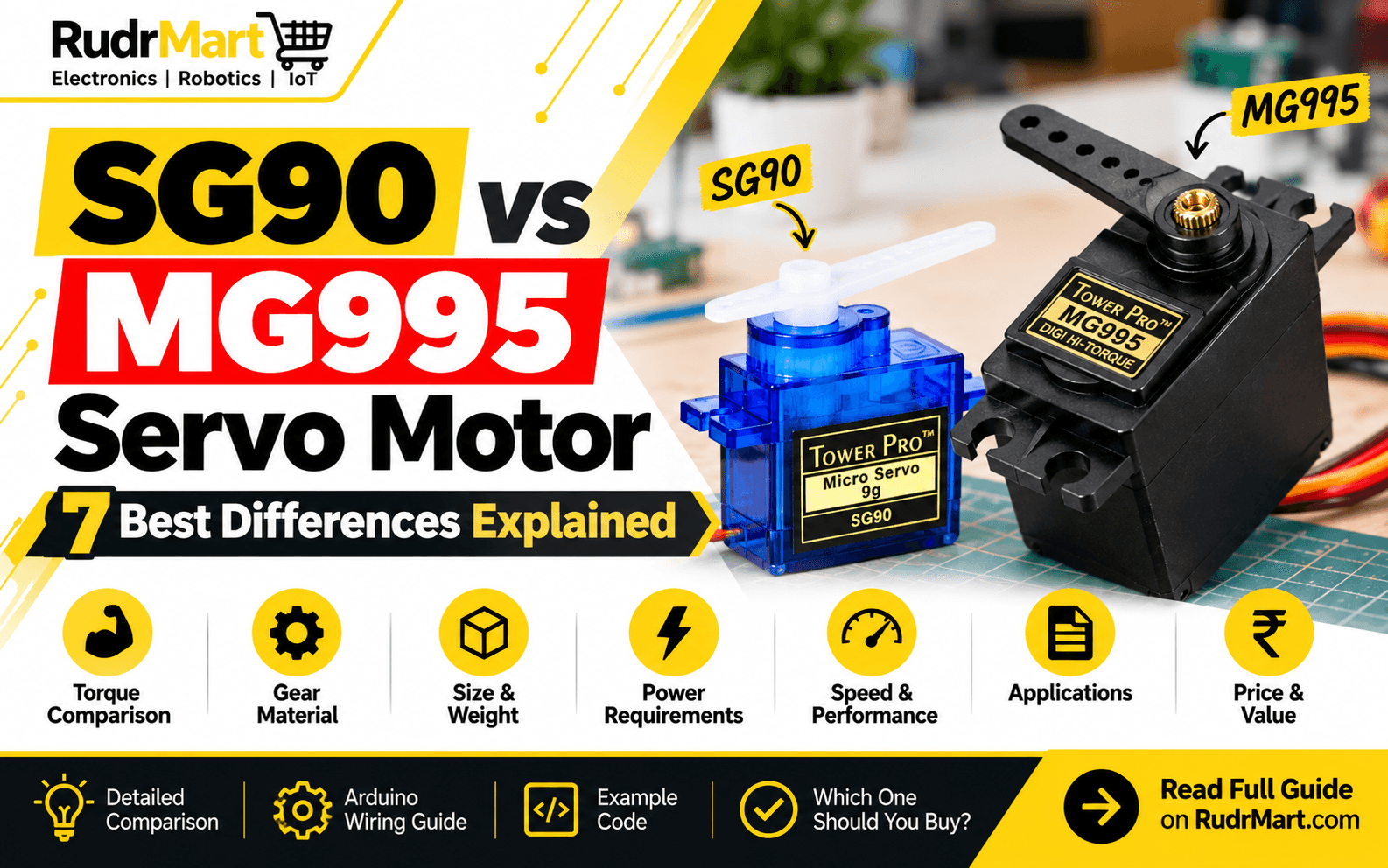
SG90 vs MG995 Servo Motor is an important comparison for students, robotics enthusiasts, Arduino beginners, and electronics developers looking for precise movement control. Both servo motors are popular in DIY electronics, but their torque, construction, power requirements, and applications are significantly different.
Choosing the wrong servo motor can result in poor performance, unstable movement, overheating, or mechanical failure. Therefore, understanding these differences helps you select the most suitable motor for your project.
In this comprehensive guide, we will compare the SG90 vs MG995 Servo Motor, explore their technical specifications, explain Arduino connections, and help you make an informed purchasing decision.
Table of Contents
- What Is a Servo Motor?
- How Does a Servo Motor Work?
- What Is the SG90 Micro Servo Motor?
- What Is the MG995 Metal Gear Servo Motor?
- SG90 vs MG995 Servo Motor: Technical Comparison
- SG90 vs MG995 Servo Motor: 7 Key Differences
- How to Connect Servo Motors with Arduino
- Arduino Servo Motor Programming
- Common Servo Motor Problems and Solutions
- Which Servo Motor Should You Choose?
- Buy Servo Motors Online at RudrMart
- Frequently Asked Questions
- Conclusion
What Is a Servo Motor?
A servo motor is an electromechanical device designed to control angular position using a feedback mechanism.
Unlike an ordinary DC motor, which typically rotates continuously when powered, a standard positional servo motor moves to a commanded angular position within its supported range.
Servo motors are commonly used in robotics, RC vehicles, automation systems, robotic arms, camera positioning systems, and educational electronics projects.
A typical hobby servo motor contains:
- A DC motor that generates mechanical movement.
- A gearbox that increases available output torque.
- A position sensor that measures shaft position.
- An electronic controller that processes control signals.
- An output shaft that transfers movement to the mechanism.
Together, these components enable controlled movement in compact electronic systems.
How Does a Servo Motor Work?
Servo motors operate using a closed-loop feedback system.
First, a microcontroller sends a control signal representing the desired position. Next, the servo’s internal controller compares that position with the actual shaft position.
If the positions differ, the motor rotates through its gearbox until the error is reduced.
Most conventional hobby servos use repeated control pulses. A pulse near 1.5 milliseconds commonly represents the center position, although the exact pulse range varies by servo model.
This controlled movement makes servo motors useful for robotics applications requiring repeatable positioning.
For more information, explore the official Arduino Servo Library.
What Is the SG90 Micro Servo Motor?
The SG90 is a lightweight, compact micro servo designed for small robotics projects and educational electronics applications.
It is especially popular among Arduino beginners because of its simple wiring, small size, and relatively low power requirements.
The SG90 generally uses plastic gears and weighs approximately 9 grams.
SG90 Servo Motor Specifications
| Specification | SG90 Micro Servo |
|---|---|
| Operating Voltage | 4.8V–6V DC |
| Weight | Approximately 9 g |
| Gear Material | Plastic |
| Stall Torque | Approximately 1.8 kg·cm at 4.8V |
| Rotation | Typically up to 180° |
| Control | Hobby servo pulse signal |
| Connection | 3 wires |
| Best For | Lightweight robotics projects |
Applications of SG90 Servo Motor
The SG90 is commonly used in:
- Mini robotic arms
- Small robotic grippers
- RC airplanes
- Lightweight pan-tilt mechanisms
- Automatic sensor positioning
- Arduino learning projects
- Educational robotics kits
Because of its compact design, the SG90 is an excellent choice for projects with limited space and relatively small mechanical loads.
Buy SG90 Servo Motor: Tower Pro SG90 Micro Servo Motor 9g – RudrMart
What Is the MG995 Metal Gear Servo Motor?
The MG995 is a high-torque servo motor designed for applications requiring greater mechanical force and stronger gearing.
Unlike the SG90, the MG995 uses a metal gear mechanism, making it more suitable for many medium-load robotics applications.
It is commonly used in robotic arms, RC vehicles, mechanical actuators, and automation prototypes.
MG995 Servo Motor Specifications
| Specification | MG995 Metal Gear Servo |
|---|---|
| Operating Voltage | 4.8V–7.2V DC |
| Weight | Approximately 55–60 g |
| Gear Material | Metal |
| Stall Torque | Approximately 10 kg·cm at 4.8V |
| Stall Torque at 6V | Approximately 12 kg·cm |
| Rotation | Typically up to 180° |
| Control | Hobby servo pulse signal |
| Connection | 3 wires |
| Best For | Higher-torque robotics projects |
Applications of MG995 Servo Motor
The MG995 is suitable for:
- Robotic arm joints
- Robotic grippers requiring greater force
- RC car steering mechanisms
- Mechanical actuators
- Medium-load pan-tilt systems
- Educational automation prototypes
- Custom robotics development
However, the MG995 requires careful power supply selection because it can draw significantly more current than a micro servo.
Buy MG995 Servo Motor: TowerPro MG995 Metal Gear Servo Motor – rudrmart
SG90 vs MG995 Servo Motor: Technical Comparison
Understanding the technical differences between these motors is essential before choosing one for an electronics project.
| Feature | SG90 | MG995 |
|---|---|---|
| Motor Type | Micro servo | Standard-size servo |
| Gear Construction | Plastic | Metal |
| Weight | 9 g | 55–60 g |
| Voltage Range | 4.8–6V | 4.8–7.2V |
| Typical Stall Torque at 4.8V | 1.8 kg·cm | 10 kg·cm |
| Size | Compact | Larger |
| Power Requirement | Lower | Higher |
| Mechanical Load | Light | Medium to higher |
| Rotation | Around 180° | Around 180° |
| Ideal Users | Beginners | Beginners and experienced makers |
| Best Applications | Mini robots | Robotic arms and RC steering |
These values are indicative product specifications. Actual performance may vary with voltage, manufacturer batch, mechanical load, and operating conditions.
SG90 vs MG995 Servo Motor: 7 Key Differences
1. SG90 vs MG995 Servo Motor: Torque Comparison
Torque is one of the most important factors when selecting a servo motor.
Torque describes the rotational force a motor can generate.
The SG90 typically provides approximately 1.8 kg·cm of stall torque at 4.8V. In comparison, the MG995 is listed with approximately 10 kg·cm at 4.8V and 12 kg·cm at 6V.
Consequently, the MG995 offers significantly greater turning force.
For example, a lightweight sensor mount may work well with an SG90, while a robotic arm lifting a heavier component may require an MG995.
However, stall torque is not the same as recommended continuous operating torque. Always allow a suitable safety margin.
2. Gear Material and Durability
Another major difference is gear construction.
The SG90 generally uses plastic gears, which reduce weight and make it suitable for compact projects.
The MG995 uses metal gears, which can better withstand higher mechanical loads and certain impact conditions.
Nevertheless, metal gears can still become damaged if the motor is overloaded or mechanically jammed.
For lightweight applications, plastic gears may be perfectly adequate.
3. Size and Weight Comparison
The SG90 weighs approximately 9 grams, making it suitable for small robots and compact assemblies.
Meanwhile, the MG995 weighs approximately 55–60 grams.
This difference becomes important when designing mobile robots, robotic arms, or battery-powered systems.
For example, using several heavy servo motors can increase the overall weight of a robotic mechanism.
Therefore, select the smallest servo that safely meets your torque requirements.
4. Operating Voltage and Power Consumption
The SG90 typically operates between 4.8V and 6V DC.
The MG995 product listing specifies an operating range of approximately 4.8V to 7.2V DC.
However, voltage alone does not determine the power supply requirement.
Current consumption increases when a servo moves against a mechanical load or approaches a stalled condition.
Because the MG995 produces greater torque, it generally requires a more capable power supply.
For reliable operation, use a properly rated external DC supply rather than relying on a microcontroller’s power pin.
5. Speed and Movement Performance
Servo speed is commonly specified as the time required to rotate through a particular angle, such as 60 degrees.
The MG995 product listing specifies approximately 0.20 seconds per 60 degrees at 4.8V and 0.16 seconds per 60 degrees at 6V.
The SG90 is also designed for relatively fast movement in lightweight applications.
However, speed depends on voltage, mechanical load, and individual motor characteristics.
Therefore, a higher-torque motor is not automatically faster under every operating condition.
6. Mechanical Load and Project Suitability
The SG90 is generally more suitable for small and lightweight mechanisms.
For example, it can move a compact sensor, operate a miniature gripper, or position a lightweight camera module.
The MG995 is better suited to applications requiring greater mechanical force.
Examples include robotic arm joints, larger grippers, and RC vehicle steering mechanisms.
When selecting a servo, calculate the required torque based on the load and its distance from the shaft.
A longer mechanical arm requires greater torque even when the attached load remains unchanged.
7. Cost and Overall Value
The SG90 is generally less expensive than the MG995 because of its smaller construction and lower torque capability.
However, the lowest-cost motor is not always the most economical choice.
Using an undersized servo can cause repeated failures, unstable operation, or additional maintenance.
Similarly, purchasing a high-torque servo for a very small project may increase cost, weight, and power consumption unnecessarily.
Therefore, the best value comes from choosing the servo that meets the actual requirements of your project.
How to Connect SG90 and MG995 Servo Motors with Arduino
Both motors typically use a three-wire connection.
The wiring is straightforward, but correct power supply selection is essential.
Servo Motor Wiring Connections
| Servo Wire | Connection |
|---|---|
| Red | Positive external DC supply |
| Brown or Black | Ground |
| Orange, Yellow, or White | Arduino control signal |
For a basic Arduino Uno project, connect the servo signal wire to digital pin 9.
Connect the servo’s positive wire to a suitable regulated external supply.
Finally, connect the servo ground and Arduino ground together.
Important: Do not power an MG995 directly from the Arduino Uno’s 5V pin. A suitable external power supply helps prevent voltage drops, unexpected resets, and unstable operation.
The same external-supply approach is also recommended for SG90 projects when supply capacity is uncertain or multiple servos are used.
If you are new to Arduino, read our What Is Arduino? Complete Beginner’s Guide.
Arduino Servo Motor Programming Example
Arduino provides a Servo library that simplifies position control.
The following example demonstrates basic servo movement using an Arduino Uno.
#include <Servo.h>

Servo myServo;

void setup() {
  myServo.attach(9);
  myServo.write(90);
  delay(1000);
}

void loop() {
  myServo.write(45);
  delay(1000);

  myServo.write(90);
  delay(1000);

  myServo.write(135);
  delay(1000);
}
How This Code Works
First, the program includes the Servo library.
Next, it creates a servo object and attaches it to Arduino digital pin 9.
The program then sends position commands of 45, 90, and 135 degrees, with a short delay between movements.
These commands can be used to test a positional SG90 or MG995 servo within its supported mechanical range.
For more examples and documentation, visit the Arduino Servo Library GitHub Repository.
Before connecting the motor to a mechanical assembly, test its movement without a load and confirm the safe angular limits.
Common Servo Motor Problems and Solutions
Even correctly selected servo motors can experience problems because of wiring errors, insufficient power, or excessive mechanical loading.
Servo Motor Is Not Moving
If the motor does not respond, check the power supply, ground connection, control signal, and Arduino program.
Also inspect the mechanism for obstructions.
Servo Motor Is Jittering
Jittering may occur because of unstable power, electrical noise, loose wiring, or excessive load.
Using a suitable regulated supply and secure connections can improve stability.
Servo Motor Is Overheating
Overheating can result from excessive mechanical load, prolonged stalling, or an unsuitable power supply.
Disconnect the motor and investigate the cause before continuing.
Servo Motor Is Not Reaching the Required Angle
Not every servo supports exactly the same mechanical travel.
Check the manufacturer’s specifications and avoid commanding positions beyond the safe movement range.
Servo Motor Makes Unusual Noise
Some operating noise is normal, particularly when a servo is holding a load.
However, continuous grinding or abnormal vibration may indicate gear damage, stalling, or mechanical interference.
SG90 vs MG995 Servo Motor: Which One Should You Choose?
The correct choice depends on the mechanical requirements of your project.
Choose SG90 If:
- You are learning Arduino programming.
- Your project requires a lightweight motor.
- You are building a small robot or sensor mount.
- You have limited installation space.
- You need a cost-effective servo for basic experiments.
Choose MG995 If:
- Your project requires greater torque.
- You are building a larger robotic arm.
- Your mechanism uses heavier moving components.
- You need metal gear construction.
- You can provide a suitable external power supply.
For small educational projects, the SG90 is generally the more practical starting point.
For applications requiring significantly greater turning force, the MG995 is usually the stronger option.
SG90 vs MG995 Servo Motor: Which One Should You Choose?
Choosing between the SG90 vs MG995 Servo Motor depends on your Arduino and robotics project requirements. The SG90 vs MG995 Servo Motor comparison highlights important differences in torque, size, gear material, and power consumption. For lightweight DIY electronics projects, the SG90 is a practical choice, while the MG995 is better suited for applications requiring higher torque. Understanding SG90 vs MG995 Servo Motor specifications helps beginners select the right motor and avoid common mistakes. Ultimately, this SG90 vs MG995 Servo Motor guide helps you make a better decision for your next robotics project.
Buy SG90 and MG995 Servo Motors Online at RudrMart
RudrMart provides electronic components, robotics accessories, development boards, and DIY electronics products for students, makers, and engineering enthusiasts.
Whether you are building your first Arduino project or developing a more advanced robotic mechanism, selecting suitable components is an important part of achieving reliable performance.
Explore these servo motors:
SG90 Micro Servo Motor
A compact servo suitable for lightweight robotics and educational projects.
Buy SG90 Micro Servo Motor at rudrmart
MG995 Metal Gear Servo Motor
A higher-torque servo designed for more demanding mechanical applications.
Buy MG995 Metal Gear Servo Motor at rudrmart
You can also explore additional products in the rudrmart Electronics Store.
Frequently Asked Questions (FAQs)
1. What is the main difference between SG90 and MG995 servo motors?
The SG90 is a compact micro servo with plastic gears and lower torque. The MG995 is a larger metal-gear servo offering significantly greater torque for more demanding applications.
2. Which servo motor is best for Arduino beginners?
The SG90 is generally a better choice for beginners because it is lightweight, compact, and suitable for simple robotics experiments.
3. Can an MG995 servo motor be controlled using Arduino Uno?
Yes. An Arduino Uno can control the MG995 using the Servo library. However, the motor should use an appropriate external power supply with a shared ground connection.
4. Is MG995 stronger than SG90?
Yes. Based on their listed specifications, the MG995 provides substantially greater stall torque than the SG90.
5. Can SG90 and MG995 rotate 360 degrees?
Standard positional versions are generally designed for approximately 180 degrees of travel. Continuous-rotation variants are different products and operate differently.
6. Can I use both SG90 and MG995 in one robotics project?
Yes. Both motors can be controlled in the same project, provided each receives a suitable power supply and the control system is configured correctly.
7. Which servo motor is better for a robotic arm?
The answer depends on the arm’s size, payload, linkage length, and required torque. SG90 motors can be suitable for miniature arms, while MG995 motors are more appropriate for many larger mechanisms.
8. Where can I buy SG90 and MG995 servo motors in India?
Both servo motors are listed on RudrMart, an online store offering electronics, robotics, and IoT components.
Conclusion
The SG90 vs MG995 Servo Motor comparison highlights the importance of selecting components according to their intended application.
The SG90 offers a compact, lightweight, and economical solution for beginner Arduino projects and small robotic mechanisms.
On the other hand, the MG995 provides greater torque, metal gears, and a stronger mechanical design for more demanding robotics applications.
Ultimately, neither servo is universally better. The right choice depends on torque requirements, size, weight, power supply capacity, and mechanical design.
Explore both options at RudrMart and choose the servo motor that best matches your next electronics or robotics project.
Arduino ProjectsArduino Servo MotorDIY ElectronicsMetal Gear Servo MotorMG995 Servo MotorMicro Servo Motorrobotics projectsrudrmartServo Motor ComparisonServo Motor TorqueSG90 Servo MotorSG90 vs MG995 Servo Motor