- Empty cart.
- Continue Shopping
Arduino vs ESP32: Which Microcontroller Should Beginners Choose in 2026?
- Posted on
 Deepak Joshi
- 0
- Categories: Arduino IDE,ESP32

Introduction
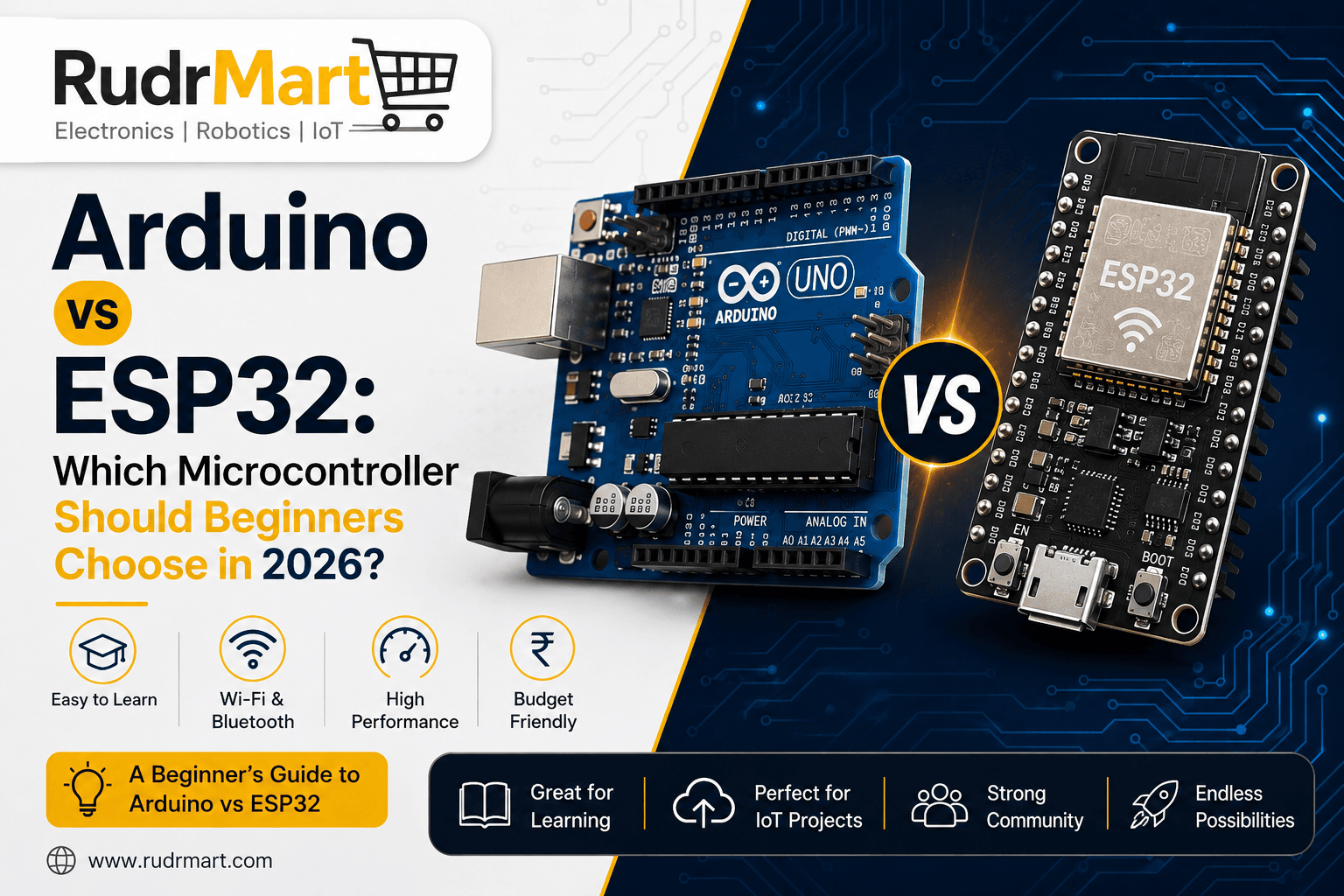
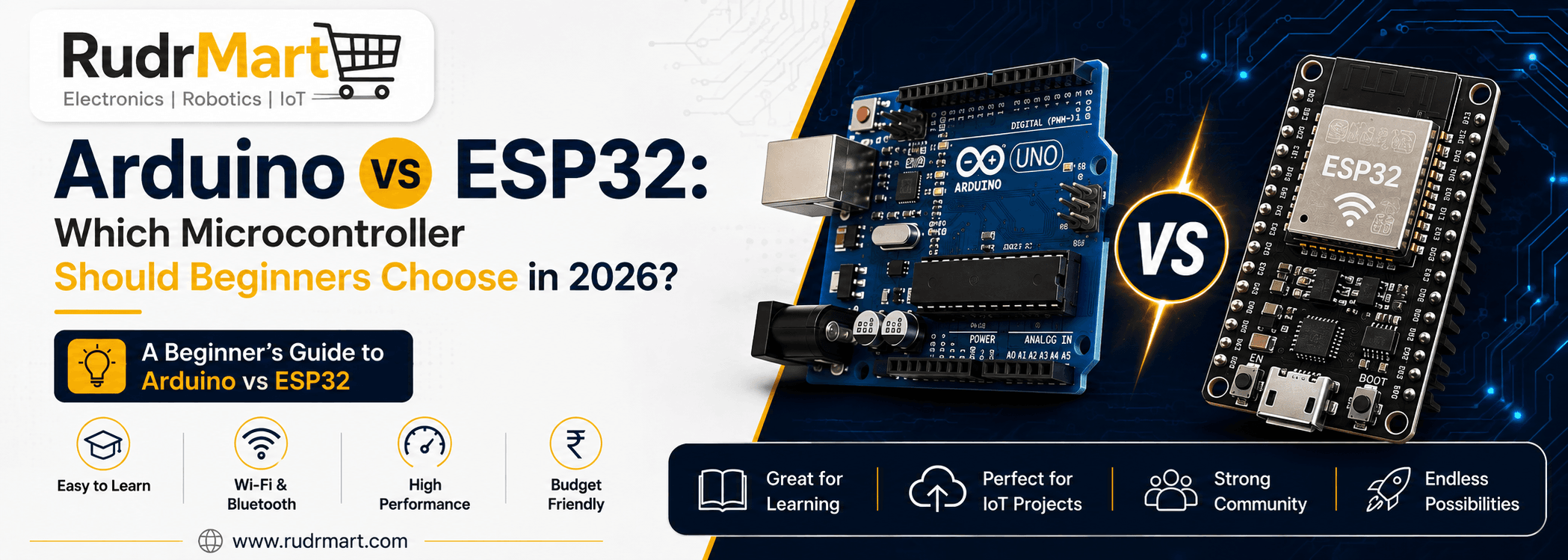
Arduino vs ESP32 is one of the most searched comparisons among electronics enthusiasts, students, and beginners entering the world of embedded systems in 2026. Both microcontrollers are powerful, affordable, and widely used for robotics, IoT, automation, and DIY electronics projects, but they serve different purposes.
If you’re wondering whether to start with Arduino Uno or an ESP32 development board, this comprehensive comparison will help you understand their differences in performance, Wi-Fi connectivity, Bluetooth capabilities, programming, pricing, and real-world applications. By the end of this guide, you’ll know exactly which microcontroller is the best choice for your learning journey and future projects.
Should I start with Arduino or ESP32?
Both are among the most popular microcontroller platforms available today, but they are designed with different goals in mind. Arduino has been the preferred choice for beginners for over a decade because of its simplicity, while ESP32 has become increasingly popular thanks to its powerful processor, built-in Wi-Fi, Bluetooth, and impressive performance.
In 2026, both platforms continue to dominate the DIY electronics market. Whether you’re building your first LED blinking circuit or creating a smart home automation system, choosing the right board can make your learning journey much easier.
In this guide, we’ll compare Arduino and ESP32 in detail to help beginners make the right decision.
What is Arduino?
Arduino is an open-source electronics platform built around easy-to-use hardware and software. Beginners can learn more through the Arduino Official Website: https://www.arduino.cc/
The most popular Arduino board is the Arduino Uno, which uses the ATmega328P microcontroller.
Arduino is designed specifically for learning electronics and programming without overwhelming beginners.
Best For
- Learning programming
- Basic electronics
- School projects
- Robotics
- Sensors
- Automation
- STEM education
What is ESP32?
ESP32 is developed by Espressif Systems. For detailed technical documentation, visit the official ESP32 documentation:
https://docs.espressif.com/projects/esp-idf/en/latest/esp32
Unlike Arduino Uno, ESP32 comes with built-in:
- Wi-Fi
- Bluetooth
- Dual-core processor
- More memory
- Higher clock speed
It is designed for IoT applications where internet connectivity is essential.
Best For
- Smart Home
- IoT Projects
- Wireless Sensors
- Home Automation
- Web Servers
- Remote Monitoring
- Industrial Automation
Before diving into the specifications, let’s compare Arduino vs ESP32 side by side to understand their strengths and limitations.
Arduino vs ESP32 Comparison
| Feature | Arduino Uno | ESP32 |
|---|---|---|
| Processor | ATmega328P | Xtensa Dual-Core |
| Clock Speed | 16 MHz | Up to 240 MHz |
| Flash Memory | 32 KB | 4 MB or more |
| SRAM | 2 KB | 520 KB |
| Wi-Fi | ❌ No | ✅ Built-in |
| Bluetooth | ❌ No | ✅ BLE + Classic |
| Operating Voltage | 5V | 3.3V |
| USB Programming | Yes | Yes |
| Analog Pins | 6 | Up to 18 |
| PWM Pins | 6 | Multiple |
| Cost | ₹500–₹900 | ₹450–₹900 |
| Difficulty | Very Easy | Beginner to Intermediate |
Performance Comparison
When comparing Arduino vs ESP32 in terms of performance, the ESP32 offers a significant advantage with its dual-core processor and higher clock speed.
Arduino Uno
- 16 MHz clock speed
- Suitable for simple automation
- Great for learning
- Stable performance
ESP32
- Up to 240 MHz
- Dual-core processor
- Multi-tasking support
- Handles complex applications easily
Winner: ESP32
Connectivity Comparison
The biggest difference in the Arduino vs ESP32 comparison is wireless connectivity. ESP32 includes built-in Wi-Fi and Bluetooth, while Arduino Uno requires additional modules.
This is where ESP32 stands out.
Arduino Uno
You need additional modules for:
- Wi-Fi
- Bluetooth
- Cloud connectivity
These modules increase both cost and complexity.
ESP32
Built-in:
- Wi-Fi
- Bluetooth Classic
- Bluetooth Low Energy (BLE)
No additional hardware is required for wireless projects.
Winner: ESP32
Programming Experience
From a programming perspective, Arduino vs ESP32 is less about syntax and more about project complexity and hardware capabilities.
Both boards can be programmed using the Arduino IDE.
Arduino
Advantages:
- Easier syntax
- Thousands of beginner tutorials
- Massive community support
- Excellent documentation
ESP32
Advantages:
- Supports Arduino IDE
- Supports PlatformIO
- Supports MicroPython
- Supports ESP-IDF
Although ESP32 is beginner-friendly, beginners may initially find wireless programming concepts more challenging.
Winner for Beginners: Arduino
Power Consumption
ESP32 includes advanced power-saving modes.
Sleep modes include:
- Deep Sleep
- Light Sleep
- Modem Sleep
This makes ESP32 perfect for battery-operated IoT devices.
Arduino Uno consumes more power unless additional optimization techniques are used.
Winner: ESP32
Approximate market prices:
Price Comparison in 2026
| Board | Price |
|---|---|
| Arduino Uno Compatible | ₹500–₹900 |
| Original Arduino Uno | ₹2,000+ |
| ESP32 Development Board | ₹450–₹900 |
Today, ESP32 often offers better value because it includes wireless connectivity at a similar price.
Community Support
Arduino has one of the largest electronics communities in the world.
You’ll find:
- Millions of tutorials
- Thousands of YouTube videos
- Official documentation
- Beginner-friendly courses
- Large library ecosystem
ESP32 also has a rapidly growing community, especially in IoT and smart home development.
Winner: Arduino
Best Projects for Arduino
Arduino is ideal for:
- LED projects
- Traffic light systems
- LCD displays
- Line-following robots
- Obstacle avoidance robots
- Servo motor control
- Ultrasonic distance measurement
- Temperature monitoring
- Automatic irrigation systems
- Electronics learning kits
Best Projects for ESP32
ESP32 excels at:
- Smart home automation
- Wi-Fi weather stations
- IoT sensor networks
- Home security systems
- Face recognition
- Smart locks
- Voice-controlled devices
- Web server projects
- MQTT applications
- Remote monitoring dashboards
Advantages of Arduino
- Extremely beginner-friendly
- Huge learning resources
- Stable platform
- Easy troubleshooting
- Wide range of compatible shields
- Excellent educational platform
Advantages of ESP32
- Built-in Wi-Fi
- Built-in Bluetooth
- Powerful processor
- Large memory
- Multiple communication interfaces
- Low power modes
- Great value for money
Which One Should Beginners Choose?
Ultimately, the Arduino vs ESP32 decision depends on your learning goals, budget, and the type of projects you want to build.
Choose Arduino If:
- You’re completely new to electronics.
- You want to understand basic programming.
- You’re learning sensors and circuits.
- You don’t need internet connectivity.
- You’re working on school or college projects.
Choose ESP32 If:
- You want to build IoT projects.
- You need Wi-Fi or Bluetooth.
- You’re interested in smart home systems.
- You want higher processing power.
- You’re planning advanced robotics or automation projects.
Can You Learn Both?
Absolutely!
A recommended learning path for beginners in 2026 is:
- Learn electronics fundamentals with Arduino.
- Understand sensors, motors, and programming logic.
- Move to ESP32 for wireless communication and IoT.
- Build cloud-connected and mobile-controlled projects.
This progression provides a strong foundation while preparing you for more advanced embedded systems.
Final Thoughts
After comparing Arduino vs ESP32, it’s clear that both boards have unique strengths. Arduino is ideal for learning electronics fundamentals, while ESP32 is better suited for IoT and connected applications.
Both Arduino and ESP32 are excellent microcontroller platforms, but the right choice depends on your goals.
If you’re just starting your electronics journey and want to build a solid understanding of circuits and programming, Arduino Uno is an excellent first step. Its beginner-friendly environment, vast community support, and educational focus make learning enjoyable and approachable.
If you’re excited about IoT, wireless communication, smart home devices, or advanced automation, ESP32 provides exceptional value with its built-in Wi-Fi, Bluetooth, faster processor, and greater memory—all at a competitive price.
Rather than viewing them as competitors, think of Arduino and ESP32 as complementary tools. Many makers begin with Arduino to master the basics and then transition to ESP32 as they take on more sophisticated projects. By learning both, you’ll develop versatile skills that are valuable for robotics, embedded systems, automation, and IoT development in 2026 and beyond.
Ready to start your next electronics project? Explore our collection of Arduino boards, ESP32 development boards, sensors, modules, and accessories to bring your ideas to life.
Frequently Asked Questions (FAQs)
1. Is ESP32 better than Arduino?
ESP32 offers more features and higher performance, including built-in Wi-Fi and Bluetooth. However, Arduino remains easier for absolute beginners.
2. Is Arduino outdated in 2026?
No. Arduino is still widely used in education, prototyping, robotics, and embedded systems learning due to its simplicity and extensive ecosystem.
3. Can ESP32 replace Arduino?
For many projects, yes. ESP32 can perform most tasks an Arduino Uno can while adding wireless connectivity. However, Arduino is still preferred for learning fundamentals.
4. Which board is better for IoT?
ESP32 is the better choice because it includes built-in Wi-Fi and Bluetooth, making it ideal for connected devices.
5. Which board is easier to learn?
Arduino Uno is generally easier for beginners because of its simple architecture, abundant tutorials, and straightforward programming environment.
6. Is Arduino vs ESP32 a fair comparison for beginners?
Yes. The Arduino vs ESP32 comparison helps beginners understand the differences in performance, connectivity, ease of use, and project suitability before choosing a development board.
ArduinoArduino IDEArduino UnoArduino vs ESP32Beginner ElectronicsDIY ElectronicsElectronics ProjectsEmbedded SystemsESP32ESP32 Development BoardIoTMicrocontrollerRobotics
