- Empty cart.
- Continue Shopping
How Do Drones Fly? 7 Amazing Secrets Behind Four Propellers
- Posted on
 Deepak Joshi
- 0
- Categories: DIY Electronics

How Do Drones Fly? Have you ever watched a quadcopter hovering in the sky and wondered how four small propellers can lift an entire machine, keep it balanced, and move it in different directions?
The secret lies in a fascinating combination of physics, aerodynamics, electronics, and intelligent control systems.
Unlike traditional airplanes, quadcopters do not need fixed wings to remain airborne. Instead, they use rotating propellers to generate thrust and adjust motor speeds to control their movements.
In this guide, we will explore 7 amazing secrets behind how drones fly, understand their essential components, and discover how beginners can learn drone engineering with a DIY drone kit.
Table of Contents
- How Do Drones Fly? Understanding the Science
- Secret 1: The Physics Behind Drone Lift
- Secret 2: Why Drones Have Four Propellers
- Secret 3: How Drones Move in Different Directions
- Secret 4: The Flight Controller — A Drone’s Brain
- Secret 5: How Drone Motors and ESCs Work
- Secret 6: How Drones Maintain Stability
- Secret 7: Batteries and Flight Time
- Learn Drone Technology with a DIY Drone Kit
- Real-World Applications of Drones
- Frequently Asked Questions
- Conclusion
How Do Drones Fly? Understanding the Science
Drones are unmanned aerial vehicles (UAVs) that can operate through remote control or onboard automation.
Different drone designs use different flying mechanisms. Fixed-wing drones rely on wings, while quadcopters use four rotating propellers.
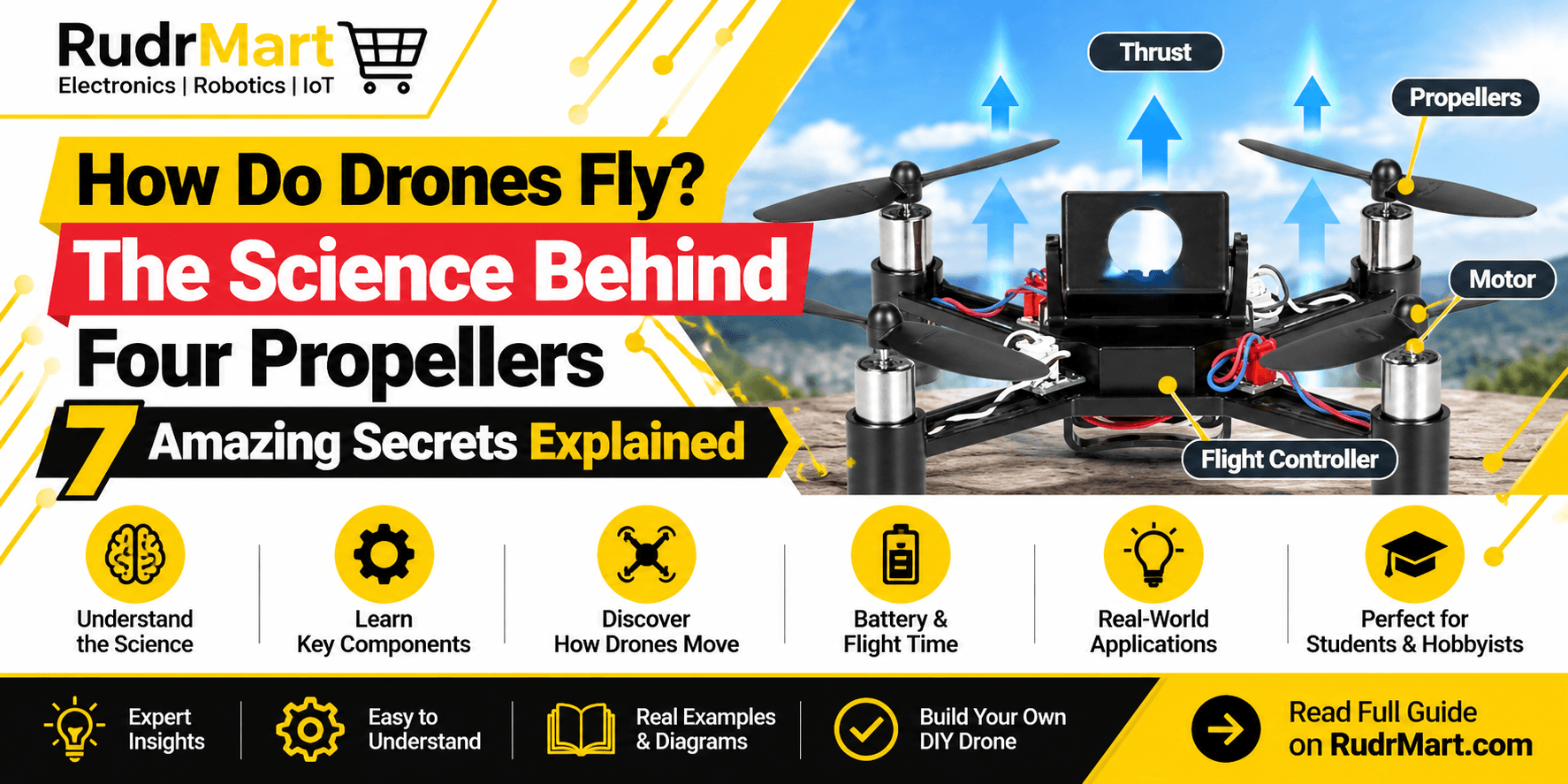
Each propeller accelerates air downward, producing an upward reaction force called thrust.
When the combined upward thrust becomes greater than the drone’s weight, the quadcopter rises.
When the forces balance, the drone can hover.
This simple principle is the foundation of quadcopter flight.
Secret 1: The Physics Behind Drone Lift
The first secret behind how drones fly is Newton’s Third Law of Motion.
This law explains that every action produces an equal and opposite reaction.
When drone propellers push air downward, the air exerts an upward force on the propellers.
That upward force allows the drone to lift off.
Understanding Thrust and Gravity
Two important forces determine a drone’s vertical movement:
- Thrust: The force generated by rotating propellers.
- Gravity: The force pulling the drone toward Earth.
| Thrust Condition | Drone Movement |
|---|---|
| Thrust greater than weight | Drone ascends |
| Thrust equal to weight | Drone hovers |
| Thrust less than weight | Drone descends |
For example, a drone weighing 1 kilogram requires approximately 9.81 newtons of total upward thrust to hover in still air.
Understanding this relationship is essential for designing efficient quadcopters.
For additional learning, explore NASA’s Science Behind Quadcopters.
Secret 2: Why Do Drones Have Four Propellers?
One fascinating aspect of how drones fly is their four-propeller arrangement.
A conventional quadcopter uses four motors positioned around its frame.
Two propellers rotate clockwise, while the other two rotate counterclockwise.
Why Opposite Rotation Matters
Rotating propellers create reaction torque, which tends to turn the drone’s body in the opposite direction.
By using opposite propeller rotation directions, a quadcopter can balance these torques during normal flight.
This arrangement offers several advantages:
- Efficient control of vertical lift
- Independent motor-speed adjustment
- Controlled rotation around the vertical axis
- Compact mechanical design
- Precise maneuverability
The correct propeller orientation is critical. Incorrect installation can prevent a drone from flying safely.
Secret 3: How Drones Move Forward, Backward, and Sideways
A drone does more than move vertically.
It can tilt, rotate, and travel horizontally by changing the thrust generated by individual motors.
Three important rotational movements make this possible.
Pitch — Forward and Backward
Pitch describes rotation around the drone’s side-to-side axis.
When the drone tilts forward, some of its thrust acts horizontally, allowing forward acceleration.
Tilting backward produces movement in the opposite direction.
Roll — Left and Right
Roll describes rotation around the drone’s front-to-back axis.
By adjusting thrust between the left and right motors, the drone tilts sideways.
This allows it to accelerate left or right.
Yaw — Turning Around
Yaw describes rotation around the vertical axis.
A quadcopter changes its yaw by creating a difference in reaction torque between clockwise and counterclockwise propeller pairs.
This allows it to turn without needing a separate steering mechanism.
Together, pitch, roll, yaw, and throttle enable controlled drone flight.
Secret 4: The Flight Controller Is a Drone’s Brain
Another important secret behind how drones fly is the flight controller.
A flight controller is an electronic system responsible for maintaining stability and processing pilot commands.
It continuously receives information from sensors and adjusts motor outputs.
How Does a Flight Controller Work?
A typical flight controller performs these operations:
- Receives commands from the radio receiver.
- Measures movement using onboard sensors.
- Compares actual motion with the desired motion.
- Calculates necessary corrections.
- Sends commands to motor speed controllers.
This process repeats continuously during flight.
Important Drone Sensors
Gyroscope: Measures angular velocity to detect rotation.
Accelerometer: Measures acceleration and supports orientation estimation.
Barometer: Helps estimate altitude changes in equipped drones.
GPS/GNSS: Provides positioning information in drones with satellite navigation capabilities.
These technologies allow modern drones to respond rapidly to movement and environmental disturbances.
Secret 5: How Drone Motors and ESCs Work
Electric motors are responsible for rotating drone propellers.
Many hobby quadcopters use brushless DC motors because of their efficiency, responsiveness, and power-to-weight performance.
However, motors cannot operate correctly without suitable electronic control.
What Is an ESC?
An Electronic Speed Controller (ESC) regulates the electrical power delivered to a motor.
The flight controller sends commands to the ESC, which controls motor operation.
When the drone needs to change direction, the flight controller adjusts motor outputs through the ESCs.
What Affects Drone Motor Performance?
Several factors influence thrust and efficiency:
- Motor speed
- Propeller diameter
- Propeller pitch
- Battery voltage
- Air density
- Total drone weight
Selecting compatible motors, ESCs, propellers, and batteries is essential for reliable operation.
Secret 6: How Do Drones Maintain Stability in the Air?
One of the most impressive aspects of how drones fly is their ability to remain relatively stable while hovering.
Even small changes in wind or movement can disturb a drone.
The flight controller detects these disturbances and continuously adjusts motor speeds.
What Is PID Control?
Many drones use a feedback method called PID control.
PID stands for:
- Proportional
- Integral
- Derivative
These control terms help the system correct differences between the desired and measured movement.
For example, if a gust of wind causes the drone to tilt unexpectedly, the flight controller can command corrective motor changes.
However, attitude stabilization alone does not guarantee that a drone will remain in the same position.
Position-hold functions generally require additional sensors or navigation systems.
Secret 7: How Drone Batteries Affect Flight Time
Battery performance plays a major role in drone flight.
Most hobby quadcopters use rechargeable lithium-polymer (LiPo) batteries because they can provide high current while remaining relatively lightweight.
What Determines Drone Flight Time?
Flight duration depends on several factors:
- Battery capacity and condition
- Drone weight
- Motor and propeller efficiency
- Flying speed and maneuvers
- Wind conditions
- Additional equipment or payload
Increasing battery capacity does not always produce proportionally longer flights because larger batteries also add weight.
For efficient drone operation, designers must balance battery capacity, weight, and power consumption.
Always use a compatible charger and follow battery safety instructions.
Learn Drone Technology with a DIY Drone Kit
Now that you understand how drones fly, the next step is exploring the technology practically.
Building a quadcopter introduces students and hobbyists to several engineering concepts, including:
- Aerodynamics and thrust generation
- Electronic motor control
- Flight stabilization
- Wireless communication
- Power distribution
- Mechanical assembly
Explore the Rudr Mart DIY Drone Kit
The DIY Drone Kit from Rudr Mart offers an opportunity to learn quadcopter assembly and electronics.
According to the product listing, the kit includes a quadcopter frame, four brushless motors, electronic speed controllers, a flight controller, propellers, radio-control components, battery, charger, and assembly hardware.
The kit is designed for educational and hobby applications.
Beginners should follow the supplied assembly instructions and seek experienced supervision when necessary.
Explore the DIY Drone Kit at Rudr Mart
You can also explore additional electronics and robotics components at Rudr Mart for future DIY projects.
Real-World Applications of Drone Technology
Understanding how drones fly helps explain why drones have become valuable across many industries.
Agriculture
Drones can assist with crop monitoring, agricultural mapping, and specialized spraying operations.
Infrastructure Inspection
Engineers use drones to inspect bridges, towers, buildings, and other structures.
Aerial Photography
Camera-equipped drones capture photographs and videos from perspectives that are difficult to achieve from the ground.
Surveying and Mapping
Specialized drones collect aerial imagery and measurement data for surveying applications.
STEM Education
Schools and engineering students use drone projects to explore physics, robotics, electronics, and programming.
These applications demonstrate how fundamental flight principles support modern engineering innovations.
How Do Drones Fly? Exploring the Technology Behind Quadcopter Flight
How Do Drones Fly is one of the most interesting questions for beginners exploring robotics and aviation technology. To understand How Do Drones Fly, we need to examine how four propellers, powerful motors, and intelligent flight controllers work together. Each propeller generates thrust, while onboard sensors help maintain balance and stability. When learning How Do Drones Fly, it is important to understand how changing motor speeds allows a drone to move forward, backward, sideways, and upward. Another fascinating aspect of How Do Drones Fly is how gyroscopes and accelerometers help the flight controller respond to movement. By experimenting with DIY drone kits, students can practically discover How Do Drones Fly and develop valuable skills in electronics, robotics, and engineering.
Frequently Asked Questions (FAQs)
1. How do drones fly without wings?
Quadcopters use rotating propellers to push air downward. The resulting upward thrust allows them to take off and remain airborne.
2. Why do drones use four propellers?
Four propellers allow quadcopters to generate lift and control pitch, roll, and yaw through motor-speed adjustments.
3. Can a drone fly with only three propellers?
Specialized tricopter designs exist, but a conventional quadcopter generally cannot maintain normal controlled flight after losing one propeller.
4. What keeps a drone stable in the air?
A flight controller uses sensor measurements and feedback algorithms to continuously adjust motor speeds and maintain the desired orientation.
5. How long can a DIY drone fly?
Flight time depends on battery capacity, weight, motors, propellers, and flying conditions. Always check the specifications of the particular kit.
6. Are DIY drones suitable for beginners?
DIY drone kits can be suitable for beginners interested in STEM and robotics. Proper assembly guidance, safety precautions, and supervision are important.
7. Where can I buy a DIY drone kit in India?
You can explore the Rudr Mart DIY Drone Kit for product specifications, components, and purchasing information.
Conclusion
Understanding how drones fly reveals the fascinating engineering behind modern quadcopters.
From Newton’s Third Law and propeller-generated thrust to flight controllers, brushless motors, and stabilization algorithms, every component contributes to controlled flight.
The four-propeller design makes it possible for a quadcopter to rise, hover, tilt, and rotate with remarkable precision.
For students, hobbyists, and future engineers, drone technology provides an exciting opportunity to connect classroom physics with real-world electronics.
Ready to explore drone engineering?
Discover the DIY Drone Kit at Rudr Mart and begin your hands-on learning journey.
DIY Drone KitDrone Flight ControllerDrone MotorsDrone PhysicsDrone PropellersDrone ScienceDrone TechnologyHow Do Drones FlyQuadcopterrobotics projectsSTEM Education