- Empty cart.
- Continue Shopping
Sensor Fusion: 7 Amazing Ways IoT & Robots Think Smarter
- Posted on
 Deepak Joshi
- 0
- Categories: Electronics & IoT

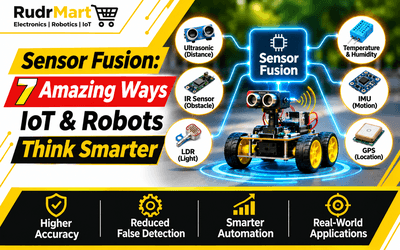
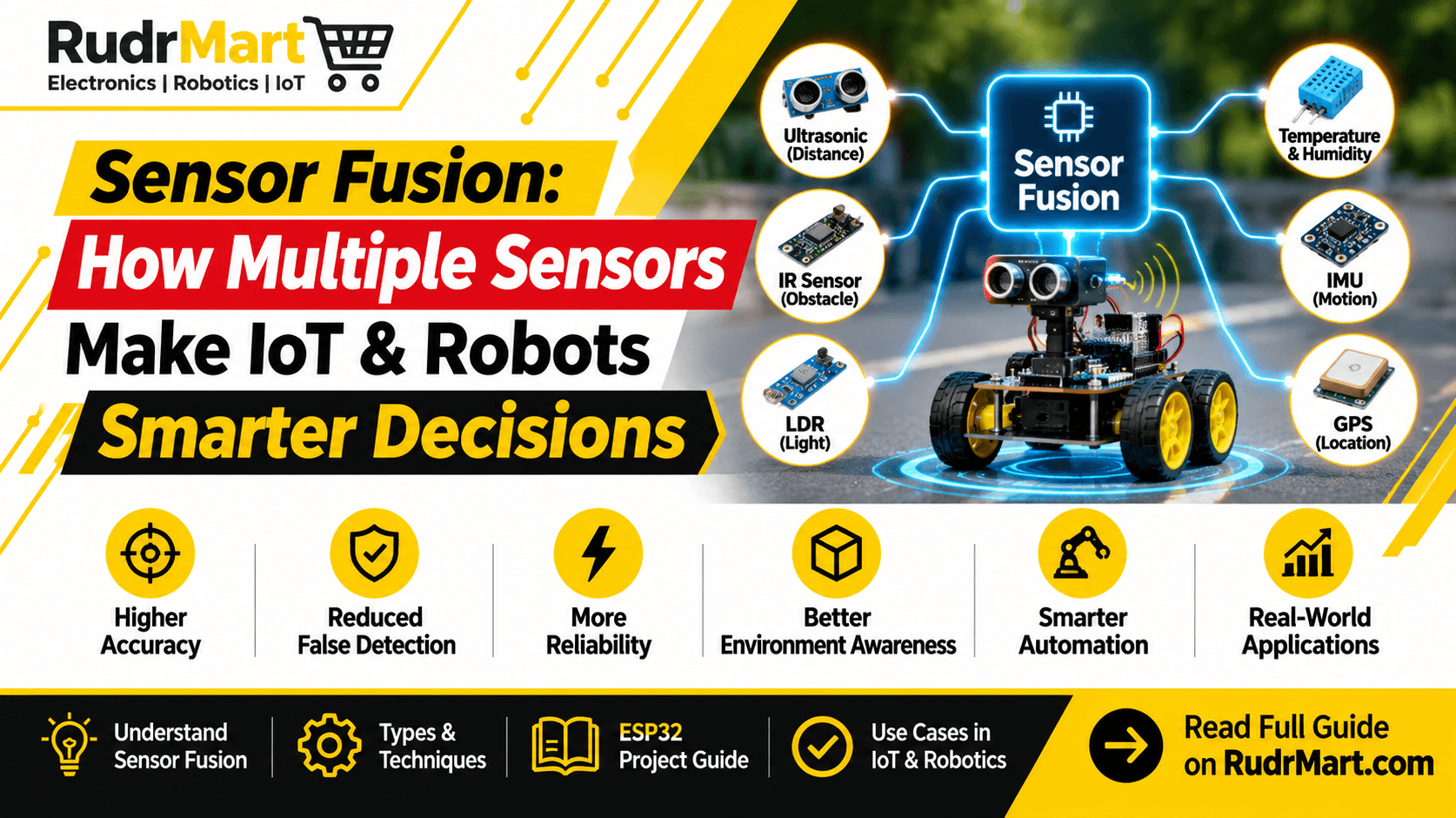
What happens when one sensor gives an incorrect reading, misses an object, or cannot understand what is happening around it? This is where Sensor Fusion becomes important. Instead of depending on a single sensor, smart devices can combine information from multiple sensors to build a more reliable understanding of their surroundings.
From robots and smart home systems to autonomous vehicles and industrial automation, Sensor Fusion helps electronic systems make better-informed decisions. It allows a device to use the strengths of different sensors while reducing the limitations of individual ones.
In this guide, we will explore how it works, its major types, real-world applications, and how beginners can experiment with a simple ESP32-based project.
Table of Contents
- What Is Sensor Fusion?
- Why Do Smart Devices Need Multiple Sensors?
- How Does Sensor Fusion Work?
- 7 Amazing Applications of Sensor Fusion
- Types of Sensor Fusion
- Try a Simple ESP32 Sensor Fusion Project
- Challenges and Limitations
- Frequently Asked Questions
What Is Sensor Fusion?
Sensor Fusion is the process of combining information from two or more sensors to produce a more useful, accurate, or reliable understanding of an environment or situation.
Think of a robot approaching an obstacle. An ultrasonic sensor can estimate the distance to an object, while an infrared sensor may detect an object within its own detection range. Each sensor provides different information.
A controller can evaluate both readings and decide whether the robot should stop, slow down, or continue moving.
The important point is that combining sensor data does not always mean calculating an average. Sometimes the system compares readings, checks confidence levels, or uses rules to make a final decision.
In simple terms:
Multiple Sensors + Data Processing + Intelligent Decision = Sensor Fusion
Why Do Smart Devices Need Multiple Sensors?
Every sensor has limitations. A sensor may work well in one situation but provide unreliable information in another.
For example:
- An ultrasonic sensor can have difficulty detecting certain object shapes or materials.
- An infrared sensor may be affected by surface properties and ambient light.
- An LDR measures light intensity but cannot identify the object creating a shadow.
- A temperature sensor cannot independently explain why the temperature has changed.
Using complementary sensors can help a system understand more than one measurement alone.
Here are some important benefits:
1. Better decision-making: Multiple sources of information can help a controller make a more informed decision.
2. Reduced false detection: A second sensor can help verify whether a detection is meaningful.
3. Improved reliability: If one sensor temporarily provides an unreliable reading, other information may help the system respond more safely.
4. Wider environmental awareness: Different sensors can detect different physical properties, such as distance, temperature, light, movement, and orientation.
5. Smarter automation: A system can respond to a combination of conditions instead of relying on a single trigger.
How Does Sensor Fusion Work?
A typical Sensor Fusion system follows a series of processing steps.
Step 1: Collect Sensor Data
The system receives readings from connected sensors. These may include distance, temperature, acceleration, light intensity, or location data.
Step 2: Preprocess the Readings
The controller checks the incoming data, removes invalid readings where possible, and applies filtering or calibration corrections.
Step 3: Synchronize the Data
When multiple sensors operate at different sampling rates, their readings may need to be aligned in time. This is especially important in moving systems such as robots and autonomous vehicles.
Step 4: Combine the Information
The system uses an appropriate method to combine the readings. It may compare raw values, extract useful features, or evaluate individual sensor decisions.
Step 5: Make a Decision
The controller uses the combined information to perform an action, such as stopping a robot, activating an alarm, or updating a display.
7 Amazing Applications of Sensor Fusion
Sensor Fusion is already used in many technologies that interact with the physical world.
1. Autonomous Vehicles
Autonomous vehicles use different sensing technologies to understand their surroundings. Cameras, radar, LiDAR, GPS, and inertial sensors can provide complementary information.
For example, a camera can provide visual details, while radar can help estimate the distance and speed of detected objects. Combining these sources helps the vehicle build a more complete picture of its environment.
2. Robotics and Obstacle Detection
Robots often use ultrasonic sensors, infrared sensors, cameras, encoders, and other sensing devices.
A mobile robot can use different sensors to detect nearby obstacles, estimate movement, and navigate its environment.
3. Smart Home Automation
A smart home system can combine motion, light, temperature, and door sensors.
For example, a lighting system could consider both room occupancy and ambient brightness before switching on a light.
This is more flexible than activating a light whenever a motion sensor detects movement.
4. Industrial Automation
Industrial machines use sensors to monitor temperature, vibration, pressure, speed, and other operating conditions.
Combining these readings can help monitoring systems identify unusual operating patterns and provide early warnings for inspection.
5. Smartphones and Wearables
Modern smartphones use accelerometers, gyroscopes, and other sensors for motion and orientation-related functions.
Android also supports composite sensors that can be generated by processing information from multiple physical sensors.
6. Drones and Navigation Systems
Drones use combinations of GPS, accelerometers, gyroscopes, barometers, and other sensors to estimate their position, movement, and orientation.
The combined information helps flight-control systems maintain stability and navigate more effectively.
7. Environmental Monitoring
Environmental monitoring systems can combine temperature, humidity, air-quality, light, and rain-sensor readings.
For example, a smart greenhouse can use several measurements to decide when ventilation or irrigation may be required.
Types of Sensor Fusion
Sensor Fusion is commonly explained through three main processing levels.
| Type | How it works | Example |
|---|---|---|
| Data-level fusion | Combines raw sensor measurements | Combining compatible measurements from two sensors |
| Feature-level fusion | Combines features extracted from sensor data | Combining detected object positions from different sensors |
| Decision-level fusion | Combines decisions made by individual sensors or processing units | Comparing obstacle-detection results from two sensors |
Data-Level Fusion
At this level, the system combines raw measurements before extracting higher-level features.
For example, two calibrated sensors measuring the same physical quantity may provide readings that can be combined using an appropriate estimation method.
Feature-Level Fusion
Here, each sensor’s data is processed first. The system then combines useful information such as object position, edges, movement patterns, or detected features.
Decision-Level Fusion
Each sensor or processing unit makes an individual decision. The controller then combines those decisions using rules, voting, confidence scores, or statistical methods.
This approach can be useful when sensors measure different physical properties and their raw readings cannot be directly compared.
Try a Simple ESP32 Sensor Fusion Project
Beginners can understand the basic concept by building a small obstacle-detection system using an ESP32, an HC-SR04 ultrasonic sensor, and an IR proximity sensor.
Components Required
- ESP32 development board
- HC-SR04 ultrasonic sensor
- IR proximity sensor module
- Breadboard
- Jumper wires
- Suitable power supply
- Optional OLED display
You can explore the components here:
How the Project Works
The ultrasonic sensor estimates the distance to an obstacle. The IR sensor provides a separate detection signal based on its proximity-sensing method.
The ESP32 reads both inputs and applies a decision rule.
An illustrative decision table could look like this:
| Ultrasonic reading | IR detection | Possible system response |
|---|---|---|
| Object nearby | Detected | Stop the robot |
| Object nearby | Not detected | Slow down or verify the distance |
| Object far away | Detected | Check sensor alignment and detection range |
| Object far away | Not detected | Continue moving, if other safety conditions allow |
These are example rules, not universal sensor behaviours. Actual thresholds and responses must be tested and calibrated for the specific modules and environment.
Important: Do not directly average the ultrasonic distance and IR sensor output. They provide different kinds of measurements. This project demonstrates decision-level fusion, where the controller evaluates both inputs to decide what to do.
You can extend the project by adding a buzzer, motor driver, or OLED display to show the robot’s status.
Common Techniques Used in Sensor Fusion
Different applications require different methods. Some commonly used techniques include:
Weighted Average: Combines compatible measurements of the same quantity. More reliable measurements can be given greater weight. For example, if two calibrated distance sensors measure the same target and report 100 cm and 104 cm, an equally weighted average is 102 cm. This is appropriate only when the measurements are comparable and the assumptions are valid.
Complementary Filter: Combines sensor information with different strengths, often using a low-frequency and high-frequency response. It is commonly used in motion and orientation estimation.
Kalman Filter: Estimates the state of a system by combining measurements with a mathematical model and accounting for uncertainty. It is used in tracking, navigation, and robotics.
Challenges and Limitations
Although Sensor Fusion can improve system performance, it also introduces engineering challenges.
- Calibration: Sensors must be calibrated so their measurements are meaningful.
- Timing: Readings may arrive at different times or sampling rates.
- Noise: Unreliable measurements can affect the final result.
- Processing requirements: Complex algorithms may require more computing power and memory.
- Cost: Adding sensors increases hardware and integration costs.
- Algorithm selection: The fusion method must match the sensors and the application.
Adding more sensors does not automatically make a system smarter. Poorly calibrated sensors or unsuitable fusion rules can produce misleading results.
The Future of Sensor Fusion
As IoT, robotics, artificial intelligence, and autonomous systems continue to develop, combining information from multiple sensors will remain an important part of intelligent electronics.
Future systems will increasingly use machine learning, advanced estimation algorithms, and edge computing to interpret complex sensor data closer to where it is collected.
For students, makers, and electronics enthusiasts, experimenting with an ESP32 and multiple sensor modules is a practical way to understand how intelligent systems perceive and respond to their surroundings.
Frequently Asked Questions
1. What is Sensor Fusion in simple words?
Sensor Fusion means combining information from two or more sensors so that a device can make a better-informed decision.
2. Is Sensor Fusion used in robotics?
Yes. Robots can combine information from distance sensors, cameras, encoders, IMUs, and other devices to improve obstacle detection, navigation, and movement estimation.
3. Can ESP32 be used for Sensor Fusion?
Yes. An ESP32 can read multiple sensor modules and combine their outputs using programmed rules or suitable algorithms. The complexity depends on the application and processing requirements.
4. What is the difference between Sensor Fusion and multiple sensors?
Using multiple sensors simply means connecting more than one sensor. Sensor Fusion involves processing and combining their information to create a more useful estimate or decision.
5. What are the three main types of Sensor Fusion?
The three commonly described levels are data-level fusion, feature-level fusion, and decision-level fusion.
6. Does Sensor Fusion eliminate sensor errors?
No. It can help reduce uncertainty and handle some unreliable readings, but it cannot guarantee error-free results. Calibration, validation, and suitable algorithms remain important.
7. Which sensors can be used together?
It depends on the application. Examples include ultrasonic and IR sensors for obstacle detection, GPS and IMU sensors for navigation, and cameras with radar or LiDAR for environmental perception.
Conclusion
Sensor Fusion makes electronic systems more capable by allowing them to use information from multiple sources rather than depending on one sensor alone.
Whether you are building a simple ESP32 obstacle-detection project or exploring advanced robotics, understanding how sensors work together is a valuable step towards smarter electronics.
Start with two complementary sensors, experiment with their readings, and gradually build more intelligent decision-making into your projects.
Embedded SystemsESP32 ProjectsIndustrial AutomationIoT TechnologyRoboticsSensor DataSensor FusionSmart Sensors