- Empty cart.
- Continue Shopping
The Internet of Forgotten Objects: 7 Amazing Ways Digital Identity Could Transform Everyday Things
- Posted on
 Deepak Joshi
- 0
- Categories: Electronics & IoT

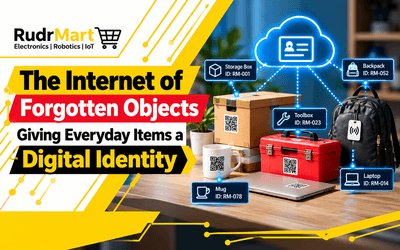
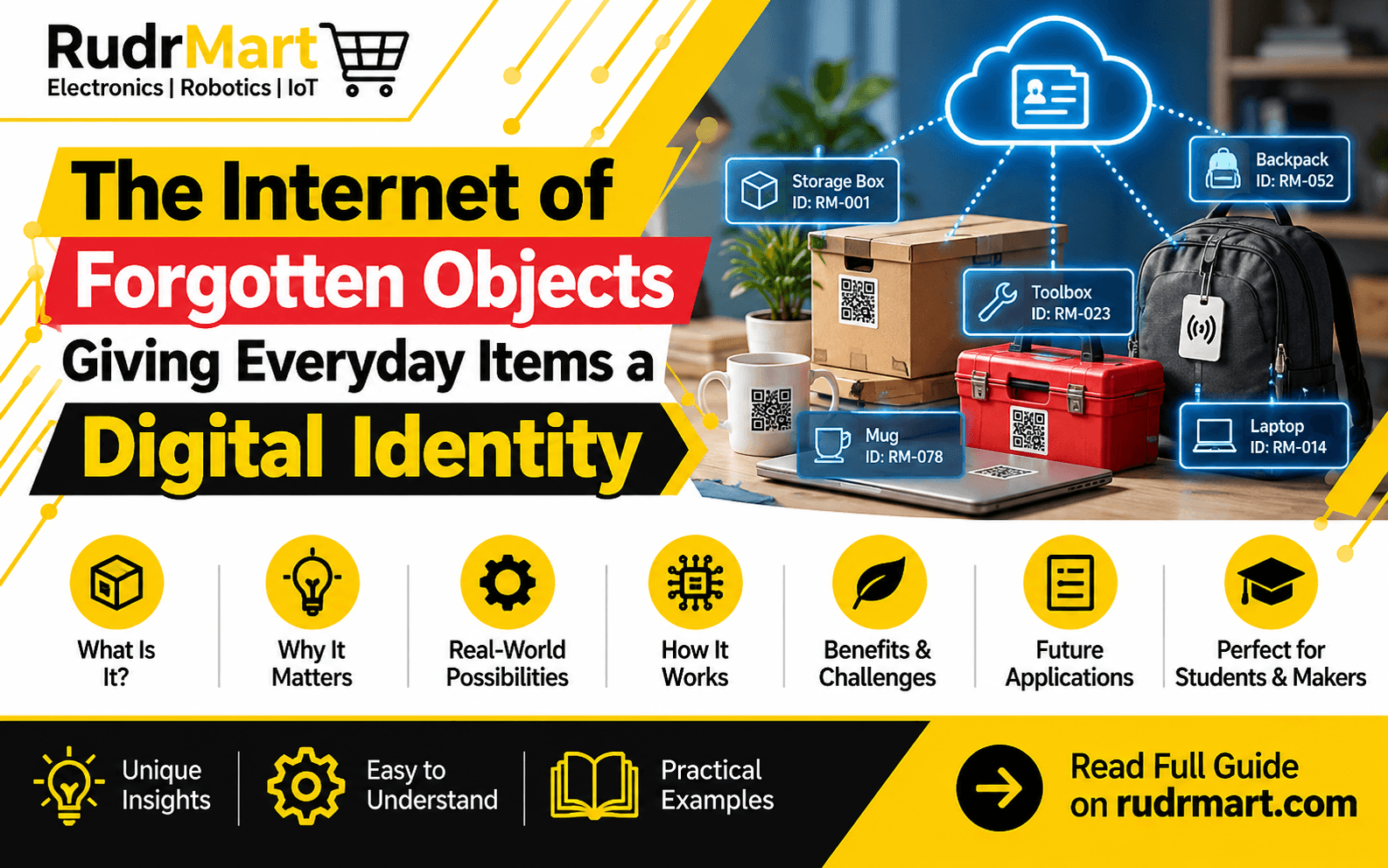
Digital identity for everyday objects could become one of the most interesting developments in the future of connected technology. Imagine a world where an old suitcase remembers its journeys, a toolbox maintains a record of its contents, or a storage container carries its own digital history.
Today, most conversations about smart technology focus on smartphones, AI assistants, autonomous vehicles and connected homes. But what about the billions of ordinary objects that have no digital presence?
A chair, a cardboard box, a hand tool or a decades-old machine may still be useful, yet none can easily communicate its identity, condition or history.
That gap opens the door to an intriguing possibility: the Internet of Forgotten Objects.
Rather than replacing everything with expensive smart products, could we gradually give existing objects a useful digital identity?
Table of Contents
- What Is the Internet of Forgotten Objects?
- Why Digital Identity for Everyday Objects Matters
- Seven Future Possibilities
- How the Technology Could Work
- What Makes an Object Truly Smart?
- Technical and Ethical Challenges
- The Role of Affordable Electronics
- Frequently Asked Questions
- Conclusion
1. What Is the Internet of Forgotten Objects?
The Internet of Forgotten Objects is a proposed way of thinking about the physical world: ordinary, overlooked or previously unconnected objects could acquire a digital identity through technologies such as QR codes, RFID, NFC, sensors and microcontrollers.
It is an editorial concept, not a formally established technical standard.
An object with a digital identity might have a unique identifier linked to information such as its ownership, maintenance records, location history or environmental exposure.
Importantly, the object itself would not necessarily need a processor, internet connection or battery.
A simple identifier could connect it to a digital record stored elsewhere.
That distinction matters because connecting every physical object directly to the internet would be expensive, difficult to maintain and often unnecessary.
2. Why Digital Identity for Everyday Objects Matters
Digital identity for everyday objects could help address a surprisingly common problem: physical possessions often lose their history as they move between people, locations and organizations.
Consider a piece of industrial equipment purchased ten years ago.
Its original documentation might be missing. Maintenance records may exist in different spreadsheets, and replacement parts might be difficult to identify.
A persistent digital identifier could make that information easier to retrieve.
The same principle could apply to household items, reusable packaging, tools, laboratory equipment and educational materials.
The larger opportunity is not simply collecting more data. It is creating a reliable connection between physical objects and the information people need about them.
3. Seven Amazing Future Possibilities
1. A Toolbox That Knows What Belongs Inside
Imagine a technician carrying a toolbox containing dozens of instruments.
Instead of manually checking every item, tagged tools could be identified when passing through a compatible RFID reading system.
The toolbox’s digital inventory could flag missing equipment before the technician leaves a worksite.
This would require suitable tags, readers and inventory software. It would not necessarily require every tool to contain a microcontroller.
2. Furniture With a Digital History
What if a second-hand chair carried a record of its manufacturer, repair history and materials?
A QR code or NFC tag could link buyers to a digital product record.
That information could make repairs, reuse and recycling easier.
It could also help owners distinguish verified information from unsupported claims about an item’s origin.
3. Storage Boxes That Remember Their Contents
Most storage containers are effectively anonymous.
Once packed and placed on a shelf, their contents are easily forgotten.
A future storage system could assign each box a unique identifier linked to an inventory record.
Optional sensors might track temperature, humidity or movement where those measurements matter.
The result could be particularly useful for archives, laboratories, warehouses and electronics workshops.
4. Old Machines With a New Digital Life
A machine does not have to be manufactured recently to participate in a connected environment.
External sensors can sometimes monitor vibration, operating temperature or other measurable conditions without replacing the machine’s original control system.
A microcontroller could collect those readings and associate them with the machine’s digital record.
However, detecting a change in a measurement is not the same as diagnosing a mechanical fault. Reliable condition monitoring requires suitable sensors, baseline data and validation.
5. Reusable Packaging With a Traceable Journey
Reusable containers frequently travel between suppliers, warehouses and customers.
A digital identifier could help record check-ins, returns, cleaning events and inspection history.
Some containers might also benefit from environmental sensors.
This approach could support reuse and accountability, provided the tracking system is practical and the records remain accurate.
6. Educational Equipment That Carries Its Own Instructions
Imagine a school electronics laboratory where every reusable kit has a scannable identity.
Students could access assembly instructions, safety notes, example projects and maintenance information directly from the kit.
Teachers could maintain records of missing or damaged components.
The most useful feature would not be constant connectivity, but easy access to trustworthy information.
7. Objects That Help Us Repair Instead of Replace
One of the most promising possibilities is a future where objects retain useful repair information.
A digital record might identify compatible spare parts, previous repairs, material composition and disassembly guidance.
This could support longer product lifetimes and reduce unnecessary replacement.
The idea also connects with the development of digital product passports, which aim to make selected product information more accessible across a product’s lifecycle.
4. How Digital Identity for Everyday Objects Could Work
Not every object needs the same technology.
A practical system could use several layers:
| Technology | Potential role |
|---|---|
| QR Code | Connect an object to an online record |
| RFID or NFC | Identify an object using a compatible reader |
| Sensors | Measure environmental or operating conditions |
| ESP32 or ESP8266 | Collect data and communicate with a local or remote system |
| Database | Store identity, events and historical records |
| Application or Dashboard | Present useful information to people |
For example, a storage container might have a QR code identifying it in a database.
A nearby sensor node could measure temperature and humidity in the storage area. The system could associate those readings with the container’s location.
The container would have a useful digital context without needing its own internet connection.
More advanced implementations might attach dedicated sensing hardware to individual assets.
The correct architecture depends on cost, power consumption, communication range, maintenance and the value of the information being collected.
5. What Makes an Object Truly Smart?
A digital identity and an intelligent device are not the same thing.
An object can be identifiable without being connected.
It can be connected without being autonomous.
And it can collect sensor data without understanding what that data means.
A useful way to think about this evolution is through four stages:
Stage 1 — Identity: The object has a unique identifier.
Stage 2 — Memory: Events and information are associated with that identifier.
Stage 3 — Awareness: Sensors provide information about the object’s environment or condition.
Stage 4 — Response: Software uses the available information to generate alerts, recommendations or authorized actions.
Not every object needs to reach Stage 4.
Sometimes a durable label and a well-maintained database are more valuable than an expensive connected device.
6. The Challenges We Cannot Ignore
The future of connected objects also raises practical questions.
Privacy: Tracking objects can indirectly reveal information about their owners and movements. Access controls and data minimization would be essential.
Security: Identifiers can be copied, tags can be replaced and poorly secured devices can be compromised. An identifier alone should not be treated as proof of authenticity.
Battery life: Maintaining millions of battery-powered devices would create substantial maintenance and environmental costs.
Interoperability: Systems built by different manufacturers may not exchange information easily.
Data quality: A digital history is only as trustworthy as the processes used to create and update it.
Long-term access: An object might last decades, while its original cloud service could disappear much sooner.
These challenges explain why the future may depend as much on durable identifiers, open data formats and responsible system design as on new electronic hardware.
7. The Role of Affordable Electronics
Affordable development boards and sensor modules make it easier for students, makers and engineers to explore parts of this vision.
For instance, the ESP32 IoT Development Board can serve as a prototype controller for collecting sensor readings and communicating over supported wireless networks.
An IR Proximity Sensor Module could help detect the presence of an object at a specific point, although it would not identify which individual object is present.
For simple network-connected experiments, an ESP8266 NodeMCU Development Board is another potential platform.
These components do not automatically create a complete digital identity system. A working implementation also needs appropriate identifiers, software, data storage, security and a clearly defined use case.
For readers interested in the underlying technologies, explore Rudr Mart’s existing guides to RFID-based identification and IoT connectivity options.
The exciting opportunity is to experiment with new uses for accessible electronics rather than assume every object needs an entirely new smart product.
This concept is closely connected to the European Union’s Ecodesign for Sustainable Products Regulation (ESPR), which introduces Digital Product Passports to improve access to information about products, their materials, sustainability and circularity. These developments suggest that digital identity could become increasingly important throughout a product’s lifecycle.
Why Digital Identity for Everyday Objects Could Shape the Future
Digital Identity for Everyday Objects could redefine how we interact with the physical world. From household belongings to industrial equipment, Digital Identity for Everyday Objects could make tracking, maintenance and information access more efficient. As IoT technology evolves, Digital Identity for Everyday Objects may help connect previously unconnected items to useful digital records without replacing them with expensive smart devices. In the coming years, Digital Identity for Everyday Objects could support smarter inventory management, easier repairs and more sustainable product lifecycles.
8. Frequently Asked Questions
What is digital identity for everyday objects?
It is the association of a physical object with a unique digital identifier and related information, such as its history, condition or ownership records.
Does every object need an internet connection?
No. QR codes, RFID tags and NFC tags can connect physical objects to digital records without requiring each object to have its own internet connection.
Can ESP32 be used to prototype a connected-object system?
Yes. An ESP32 can collect data from compatible sensors and communicate with software systems. Additional hardware and software may be needed depending on the project.
Is the Internet of Forgotten Objects the same as the Internet of Things?
Not exactly. The Internet of Things is an established category of connected devices and systems. The Internet of Forgotten Objects, as used in this article, is a proposed concept emphasizing digital identity for ordinary or previously unconnected physical items.
Could this technology help reduce electronic waste?
Potentially. Better repair information, maintenance history and reuse tracking could support longer product lifetimes. The environmental benefit would depend on the implementation and the additional hardware required.
9. Conclusion: A Future Where Objects Have Memory
Digital identity for everyday objects invites us to reconsider what it means for something to be smart.
The future may not require replacing every old object with a new connected product.
Instead, some of the most meaningful innovations could come from giving ordinary belongings a persistent identity, useful history and access to relevant information.
A forgotten toolbox, a reusable container or an aging machine could become easier to maintain, trace and reuse.
The real question is not whether every object can be connected.
It is whether giving an object a digital identity makes it more useful, repairable or sustainable.
At Rudr Mart, we believe exploring questions like these is part of building the next generation of electronics, robotics and IoT innovation.
What ordinary object would you give a digital identity first?
Connected TechnologyDigital Identity for Everyday ObjectsDigital Product PassportESP32Future of IoTInternet of Forgotten ObjectsRFID TechnologySmart ObjectsSustainable Electronics