
- Empty cart.
- Continue Shopping
Wi-Fi vs Bluetooth vs GSM vs Ethernet: Which Connectivity Is Right for Your IoT Project?
- Posted on
 Deepak Joshi
- 0
- Categories: Electronics & IoT

Introduction
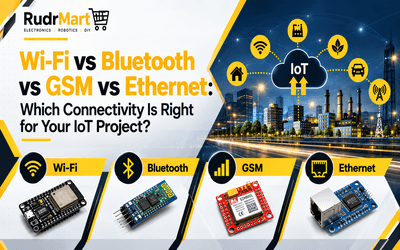
IoT connectivity plays an important role in how electronic devices communicate, collect data, and interact with other devices, networks, and cloud platforms.
The Internet of Things (IoT) has changed the way electronic devices communicate, collect data, and interact with the world around them. From smart home systems and industrial monitoring to remote sensors and automation, connectivity is at the heart of almost every IoT project.
But choosing the right communication technology can be confusing.
Should you use Wi-Fi, Bluetooth, GSM, or Ethernet?
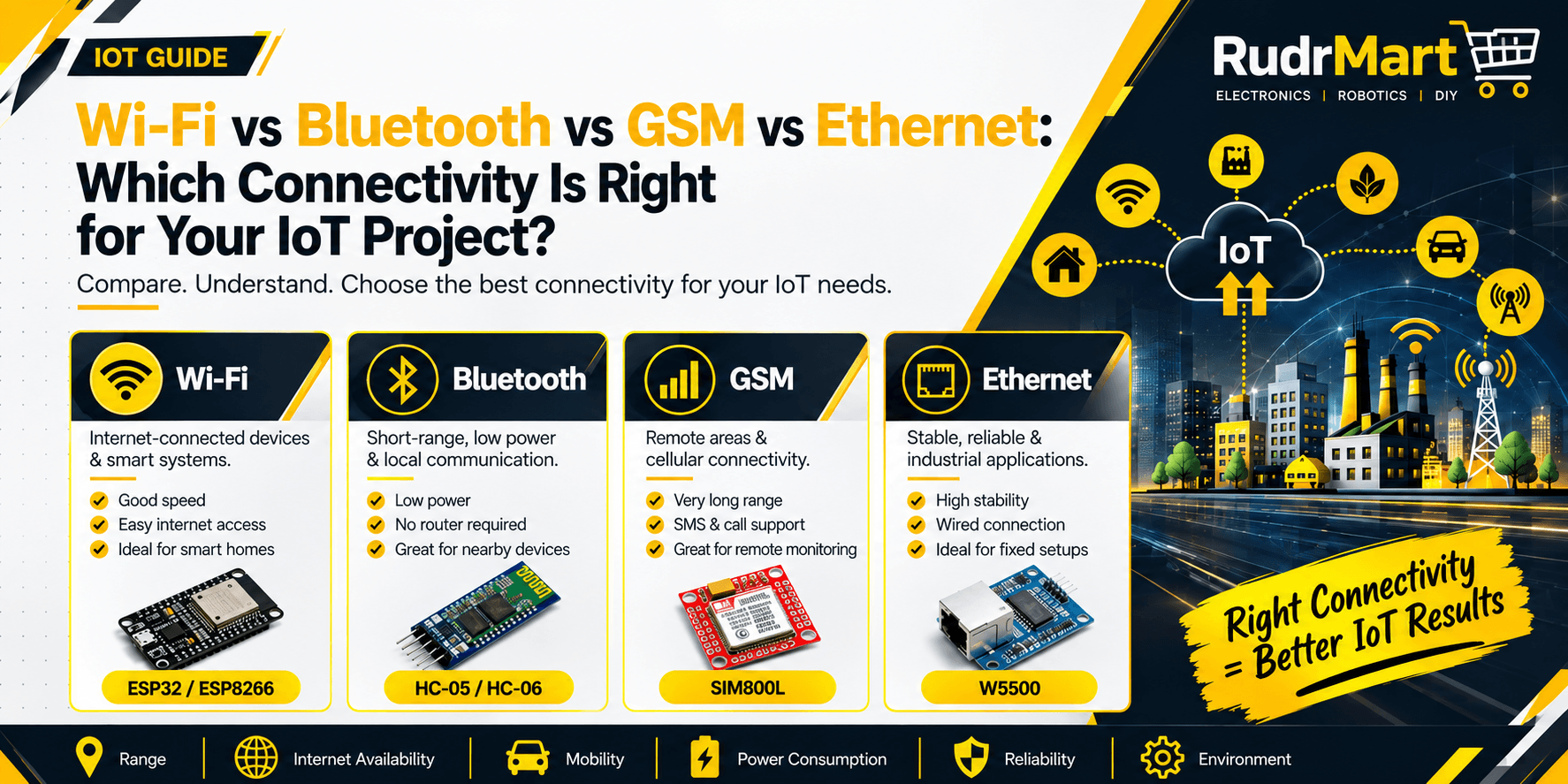
The answer depends on several factors, including range, internet availability, mobility, power consumption, reliability, and the environment in which your project will operate.
In this guide, we’ll compare these four popular connectivity options and explain where each one works best.
Wi-Fi is a popular IoT connectivity option for smart devices that require access to a local network or the internet.
What Is IoT Connectivity?
IoT connectivity refers to the communication method that allows a device to exchange information with another device, a computer, or the internet.
For example, a temperature sensor might collect data and send it to a cloud platform. A smart appliance might receive commands from a smartphone. An industrial machine might send its operating data to a monitoring system.
Different applications require different communication technologies.
The four commonly used options are:
Wi-Fi
Bluetooth
GSM
Ethernet
Let’s understand each one.
1. Wi-Fi Connectivity
Wi-Fi is one of the most widely used wireless communication technologies for IoT applications.
It allows electronic devices to connect to a local wireless network and, when that network has internet access, communicate with online services and cloud platforms.
Development boards such as ESP32 and ESP8266 are popular choices for Wi-Fi-based IoT projects. Developers can refer to the official Espressif documentation for detailed technical information about ESP32.
Official Espressif ESP32 Documentation
Advantages of Wi-Fi
- Wireless communication
- Good data transfer speed
- Easy internet connectivity
- Suitable for smart-home applications
- Works well with cloud-based IoT systems
- Widely supported by routers and networking devices
Limitations of Wi-Fi
- Usually depends on a Wi-Fi network
- Range is generally limited compared with cellular networks
- Continuous Wi-Fi communication can consume significant power
- Performance can be affected by network conditions
Best Applications
Wi-Fi is suitable for:
- Smart home automation
- IoT monitoring systems
- Web-controlled devices
- Home and office automation
- Environmental monitoring
- Connected sensors
Example: An ESP32 can collect temperature data from a sensor and send the information to an online dashboard through Wi-Fi.
2. Bluetooth Connectivity
Bluetooth is designed mainly for short-range wireless communication.
It is commonly used when devices need to communicate with nearby smartphones, computers, or other Bluetooth-enabled devices.
Bluetooth can be particularly useful when an IoT device does not need a direct internet connection but needs to communicate locally.
Advantages of Bluetooth
- Wireless communication
- Low power consumption for many applications
- Easy connection with smartphones
- Useful for short-range communication
- No Wi-Fi router is required for basic device-to-device communication
Limitations of Bluetooth
- Shorter range than GSM
- Not primarily designed for direct internet connectivity
- Less suitable for applications requiring long-distance communication
Best Applications
Bluetooth is useful for:
- Mobile-controlled projects
- Wearable devices
- Short-range sensors
- Wireless configuration
- Robotics projects
- Device-to-device communication
Example: A robot can receive commands from a smartphone through a Bluetooth module.
For nearby devices, Bluetooth provides a practical IoT connectivity solution without requiring a Wi-Fi router.
3. GSM Connectivity
GSM-based communication is useful when an IoT device needs to communicate over a cellular network.
Unlike Wi-Fi, a GSM-enabled device does not need to remain connected to a local router. This makes cellular connectivity useful for remote applications where traditional internet or Wi-Fi infrastructure may not be available.
Modules such as the SIM800L can be used in projects requiring cellular communication, including SMS, calls and mobile data depending on the module/network configuration.
GSM is an effective IoT connectivity option for remote applications where Wi-Fi infrastructure is unavailable.
Advantages of GSM
- Works over cellular networks
- Suitable for remote locations
- Does not require a local Wi-Fi router
- Useful for mobile and remote monitoring
- Can support SMS and voice functionality on compatible modules
Limitations of GSM
- Requires cellular network coverage
- Requires a suitable SIM/network service
- Data usage may involve additional costs
- Power requirements can be important during cellular transmission
Best Applications
GSM is suitable for:
- Remote monitoring
- Vehicle tracking
- Agricultural monitoring
- Security systems
- Remote alerts
- Industrial applications
- Mobile IoT devices
Example: A remote monitoring system can use a GSM module to send an alert when a sensor detects an unusual condition.
4. Ethernet Connectivity
Ethernet uses a physical network connection, usually through an Ethernet cable, to communicate with a network.
Although it does not provide the mobility of wireless technologies, Ethernet can offer a stable and reliable connection, making it useful for many industrial and fixed installations.
Modules such as the W5500 Ethernet module can provide Ethernet connectivity to compatible microcontrollers and development boards.
Ethernet is a reliable IoT connectivity option for fixed industrial and automation installations.
Advantages of Ethernet
- Stable wired connection
- Reliable communication
- Suitable for fixed installations
- Good network performance
- Useful for industrial and automation environments
- Less affected by wireless interference
Limitations of Ethernet
- Requires physical cabling
- Limited mobility
- Installation can be more complicated in some locations
- Not ideal for moving devices
Best Applications
Ethernet is suitable for:
- Industrial automation
- Factory monitoring
- Office networking
- Fixed IoT installations
- Networked machines
- Automation controllers
Example: An industrial monitoring system can use an Ethernet connection to send machine data to a local server or network.
Wi-Fi vs Bluetooth vs GSM vs Ethernet
Here is a quick comparison:
| Feature | Wi-Fi | Bluetooth | GSM | Ethernet |
| Wireless | Yes | Yes | Yes | No |
| Internet Connectivity | Yes, through network | Not directly | Yes, where supported | Yes |
| Typical Range | Medium | Short | Very long | Cable-dependent |
| Mobility | High | High | Very high | Low |
| Local Network | Yes | Device-to-device | Cellular network | Yes |
| Router Required | Usually | No | No | Usually network infrastructure |
| Best For | IoT & smart devices | Nearby devices | Remote applications | Fixed & industrial systems |
| Main Advantage | Easy internet access | Low-power local communication | Remote connectivity | Stable wired communication |
How to Choose the Right Connectivity for Your IoT Project
There is no single connectivity technology that is perfect for every project.
Consider these questions before choosing a communication method.
Choosing the right IoT connectivity technology depends on range, mobility, internet availability, power consumption, and reliability.
1. How far does the device need to communicate?
For nearby communication, Bluetooth may be enough.
For a Wi-Fi-based local IoT system, Wi-Fi can be suitable.
For remote locations, GSM may be more practical.
For fixed installations, Ethernet can provide a reliable wired connection.
2. Does your device need internet access?
If your project needs direct internet connectivity, Wi-Fi, GSM or Ethernet may be appropriate depending on the environment.
Bluetooth is generally more suitable for local communication rather than direct internet access.
3. Is the device mobile?
For moving devices, wireless technologies are generally more convenient.
GSM can be particularly useful when a device needs connectivity across large geographical areas and cellular coverage is available.
4. Is reliability important?
For a fixed installation where stable communication is important, Ethernet can be a practical choice.
For wireless applications, the choice depends on network availability, distance and environmental conditions.
5. What about power consumption?
Power consumption should always be considered in battery-powered IoT devices.
The communication technology, transmission frequency, hardware and application design can all affect battery life.
Real-World Examples
Choosing the technology becomes easier when we look at practical applications.
Smart Home
Recommended: Wi-Fi
A smart switch or sensor can connect to the home network and communicate with a mobile app or cloud service.
Smartphone-Controlled Robot
Recommended: Bluetooth
The robot can receive commands from a nearby smartphone without requiring a traditional Wi-Fi network.
Remote Agricultural Monitoring
Recommended: GSM
A monitoring device installed in a remote field can use cellular connectivity to send information where Wi-Fi infrastructure may not be available.
Industrial Monitoring System
Recommended: Ethernet
A fixed machine or controller inside a factory can use a wired Ethernet connection for stable network communication.
Can You Use More Than One Connectivity Technology?
Yes.
Many modern IoT systems use multiple communication technologies depending on their requirements.
For example, a device might use:
Bluetooth → Smartphone → Wi-Fi → Cloud
Another system could use:
Sensor → Microcontroller → GSM → Remote Server
The right architecture depends on the project requirements, available infrastructure and communication distance.
Final Thoughts
Wi-Fi, Bluetooth, GSM and Ethernet each have their own strengths and limitations.
Wi-Fi is a strong option for internet-connected devices within a local network.
Bluetooth is useful for short-range communication and smartphone-controlled applications.
GSM is useful when devices need connectivity over cellular networks, particularly for remote applications.
Ethernet is a practical choice for fixed installations where a stable wired network connection is preferred.
Before selecting a module, consider your project’s range, internet requirements, mobility, power availability, environment and communication needs.
The right connectivity choice can make your IoT project more reliable, efficient and easier to expand.
The best IoT connectivity solution ultimately depends on the specific requirements of your project.
Explore Electronics & IoT Components with rudrmart
Looking for components for your next electronics, IoT or automation project?
Explore development boards, communication modules, sensors, displays, networking modules and other electronic components at rudrmart.
From ESP32 and ESP8266 boards to GSM modules, Ethernet modules and other DIY electronics components, choose the hardware that fits your project requirements.
Build. Connect. Innovate. www.rudrmart.com
Frequently Asked Questions (FAQs)
1. Which connectivity option is best for IoT projects?
There is no single best option for every IoT project. Wi-Fi works well for internet-connected devices within a local network, Bluetooth for short-range communication, GSM for remote or mobile applications, and Ethernet for stable, fixed installations.
2. Is Wi-Fi or Bluetooth better for IoT?
It depends on the application. Wi-Fi is generally better when the device needs internet or cloud connectivity, while Bluetooth is useful for short-range communication with nearby devices such as smartphones.
3. Can an IoT device work without Wi-Fi?
Yes. IoT devices can use Bluetooth, GSM, Ethernet, or other communication technologies instead of Wi-Fi. For example, GSM can provide connectivity through a cellular network without requiring a local Wi-Fi router.
4. Which connectivity is suitable for remote IoT monitoring?
GSM can be suitable for remote monitoring when cellular coverage is available. It allows devices to communicate without relying on nearby Wi-Fi infrastructure, making it useful for agriculture, vehicle tracking, security systems, and remote monitoring applications.
5. Is Ethernet better than Wi-Fi for industrial IoT?
Ethernet can be a practical choice for fixed industrial installations where stable wired communication is important. It is less affected by wireless interference but requires physical cabling and provides limited mobility.
6. Which IoT connectivity option consumes the least power?
Power consumption depends on the hardware and how frequently the device communicates. Bluetooth can provide low-power communication for many short-range applications, while continuous Wi-Fi or cellular communication may require more power. The actual consumption also depends on the module and application design.
7. Can I use Wi-Fi, Bluetooth, and GSM in the same IoT project?
Yes. An IoT system can combine multiple connectivity technologies. For example, a device might communicate with a smartphone through Bluetooth and then use Wi-Fi for cloud connectivity.
8. Which modules can I use for Wi-Fi, GSM, and Ethernet projects?
Popular options include ESP32 or ESP8266 for Wi-Fi-based projects, SIM800L for compatible GSM/cellular applications, and the W5500 Ethernet module for wired network connectivity. The right module depends on your microcontroller, network requirements, and project environment.