- Empty cart.
- Continue Shopping
Microcontroller vs Microprocessor: What’s the Difference and Which Do You Need?
- Posted on
 Deepak Joshi
- 0
- Categories: Electronics & Embedded Systems

Introduction
If you are starting with electronics, robotics, IoT, or embedded systems, you will often hear two terms: microcontroller and microprocessor. At first, they may seem similar because both can process instructions and control electronic systems. However, they serve different purposes.
The microcontroller vs microprocessor decision can affect the performance, power consumption, cost, complexity, and capabilities of your project.
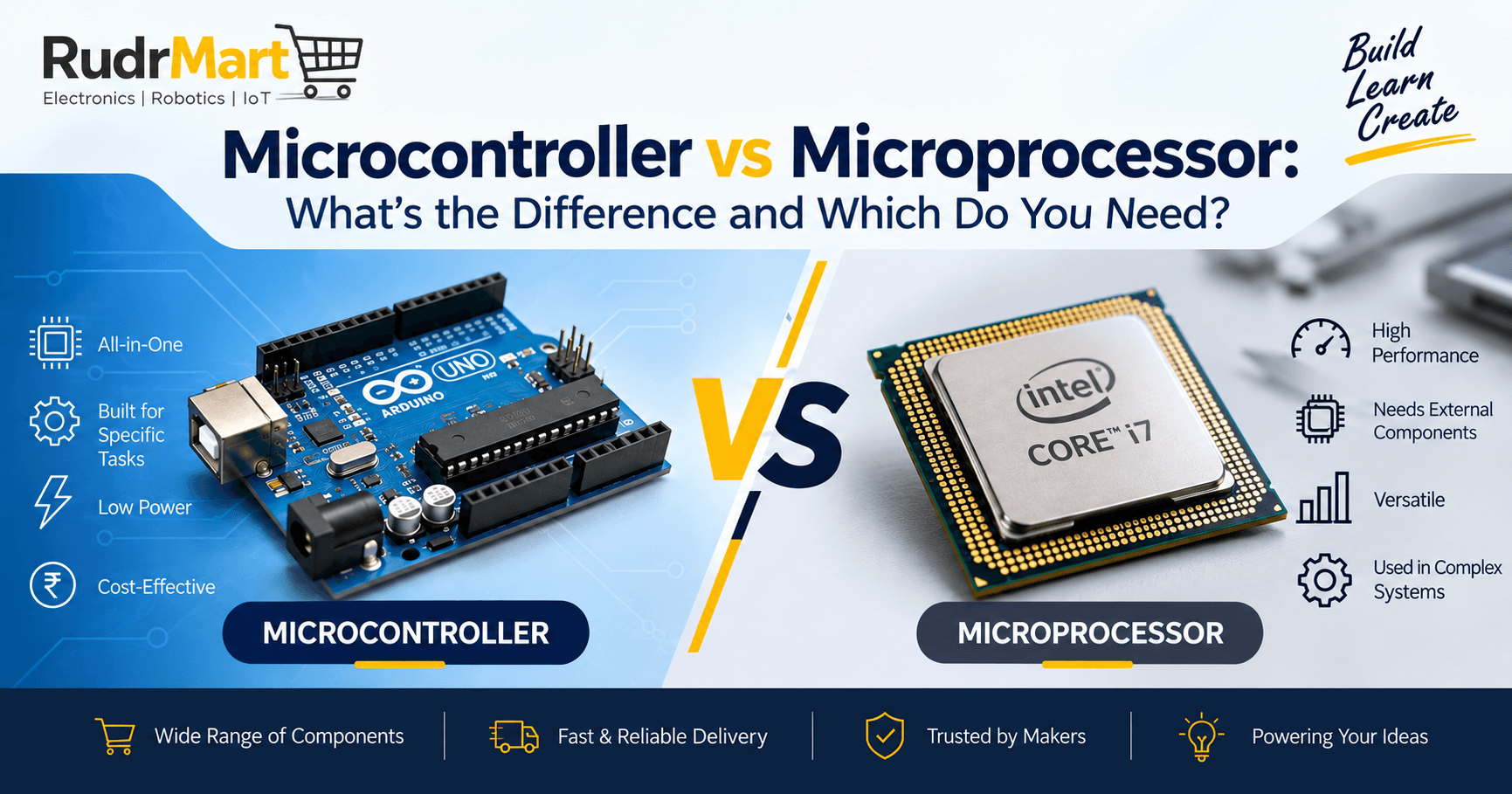
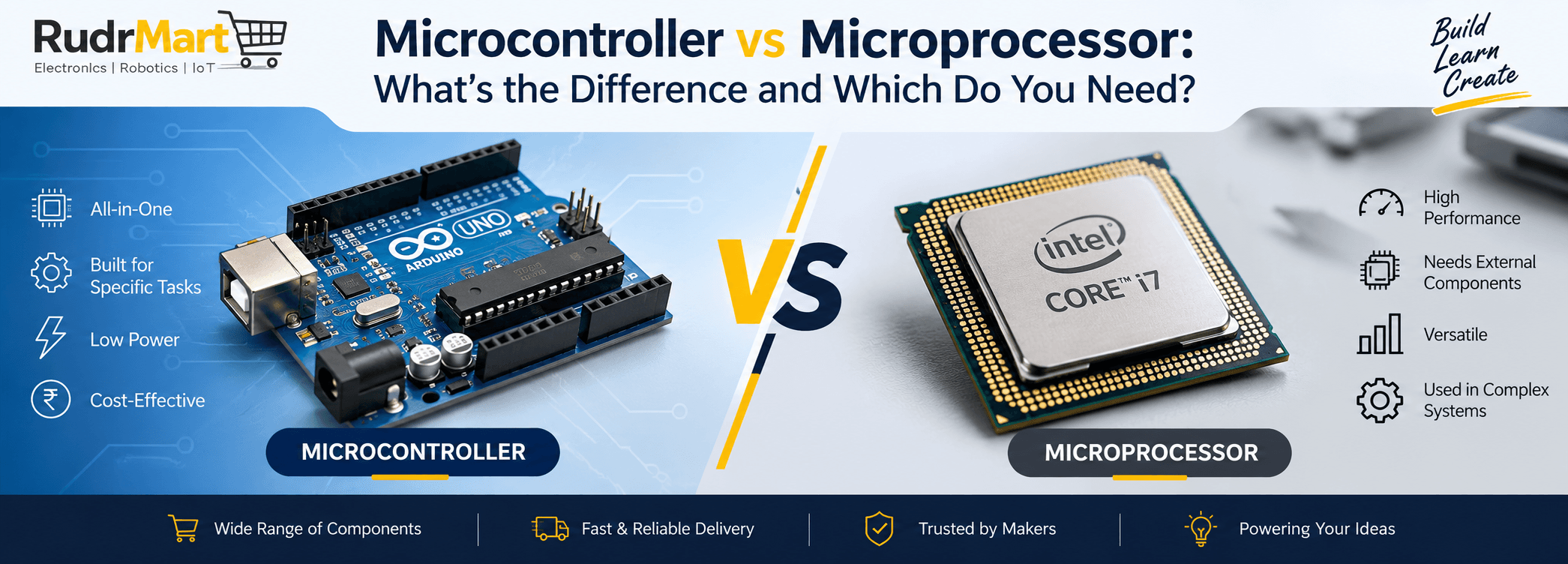
A microcontroller usually combines a CPU, memory, and several peripherals inside one integrated circuit. In contrast, a microprocessor primarily provides processing capability and commonly relies on external memory and other components to create a complete system. Modern device boundaries can overlap, but this distinction remains useful when choosing hardware.
In this guide, we will explain the difference between a microcontroller and microprocessor, explore their applications, and help you understand which one fits your project.
What Is a Microcontroller?
A microcontroller, commonly called an MCU (Microcontroller Unit), is a compact integrated circuit designed to control specific operations inside an embedded system.
A typical MCU integrates several important components into a single package, including:
- CPU
- Flash/program memory
- SRAM
- GPIO pins
- Timers and counters
- Communication interfaces
- Analog and digital peripherals
For example, modern microcontrollers can include UART, ADC, timers, internal memory, reset circuitry, and other peripherals alongside the processing core.
Because many essential components are already integrated, engineers can build compact systems with relatively few external parts. This makes microcontrollers particularly useful for electronics, automation, robotics, sensors, and IoT applications.
You can explore different microcontroller architectures and families through Microchip’s official microcontroller resources.
Common Microcontroller Examples
Popular microcontroller families include ATmega, PIC, AVR, STM32, ESP32, and many Arm Cortex-M-based MCUs.
Arduino development boards also commonly use microcontrollers, making them popular among students, makers, and developers learning embedded electronics.
Common Microcontroller Applications
You can find microcontrollers in devices such as home automation systems, robots, digital meters, sensor systems, motor controllers, smart appliances, security devices, automotive electronics, and IoT products.
Their integrated design also helps reduce the number of external components required in many applications.
What Is a Microprocessor?
A microprocessor, often referred to as an MPU (Microprocessor Unit) in embedded-system discussions, focuses primarily on processing.
The CPU executes instructions, performs calculations, and coordinates computing operations. To understand how processors execute instructions and handle computing tasks, see Arm’s CPU overview.
Unlike a traditional microcontroller, a microprocessor-based design often uses external components such as RAM, storage, and other supporting circuitry. This architecture allows designers to build systems with considerably larger memory and more sophisticated software environments.
As a result, microprocessors are well suited to applications that require advanced operating systems, complex user interfaces, large amounts of memory, or demanding computational workloads. Microchip, for example, notes that MPUs are appropriate when a design needs capabilities such as Linux, higher compute performance, external DDR memory, or advanced software stacks.
Common Microprocessor Examples
Examples include processors based on architectures such as Intel x86, AMD x86-64, and various Arm Cortex-A application processors.
Common Microprocessor Applications
Microprocessors are commonly associated with more computationally demanding systems, including PCs, laptops, advanced embedded computers, industrial computing platforms, multimedia systems, and Linux-based embedded products.
Microcontroller vs Microprocessor: Key Differences
Understanding the main differences makes choosing between the two much easier.
| Feature | Microcontroller (MCU) | Microprocessor (MPU) |
|---|---|---|
| Main purpose | Dedicated embedded control | General/advanced computing |
| CPU | Integrated | Main processing element |
| Memory | Commonly on-chip | Often uses external memory |
| Peripherals | Many integrated peripherals | Often relies more on external components |
| Power consumption | Generally lower | Generally higher |
| System cost | Often lower | Often higher |
| Board complexity | Usually simpler | Usually more complex |
| Operating system | Bare-metal firmware or RTOS common | Linux and other rich OSs common |
| Performance | Optimized for embedded control | Suited to demanding computing |
| Typical applications | Sensors, IoT, control, robotics | Computing, multimedia, advanced embedded systems |
These are general architectural tendencies rather than absolute rules. Modern MCUs have become increasingly capable, while highly integrated application processors and SoCs can blur the traditional boundary between the two categories.
1. Architecture
Architecture is one of the biggest differences in the microcontroller vs microprocessor comparison.
A microcontroller is closer to a small computer contained inside one chip. It integrates processing, memory, and several control peripherals.
A microprocessor places greater emphasis on computing capability. Therefore, a complete MPU-based system commonly combines the processor with external RAM, storage, power-management components, and other supporting hardware.
Consequently, microcontroller-based circuit boards can often be smaller and simpler.
2. Memory
Microcontrollers typically contain internal program and data memory.
Modern MCUs can include Flash memory for executable code, SRAM for variables, and sometimes EEPROM or other non-volatile memory.
However, internal memory has practical capacity limits.
Microprocessor systems can connect to much larger external memory resources. This becomes important when running a rich operating system, handling large applications, processing multimedia, or storing substantial amounts of runtime data.
Therefore, memory requirements should be one of your first considerations when selecting a processing platform.
3. Processing Performance
A microcontroller focuses on efficient control of a dedicated task. It might read sensors, operate motors, control relays, manage displays, or communicate with other electronic devices.
A microprocessor generally targets applications that require more computing resources and sophisticated software.
However, you should not assume that every MPU is automatically better than every MCU. The correct choice depends on the workload.
For example, a powerful processor may offer little practical advantage if your device only needs to read a temperature sensor and switch a relay.
4. Power Consumption
Power consumption is especially important for portable and battery-powered electronics.
Microcontrollers often support low-power operating and sleep modes. Furthermore, integrating memory and peripherals can reduce the need for multiple external components. Microchip specifically highlights low-power operation and integrated peripherals as important MCU characteristics.
Therefore, an MCU often makes sense for battery-operated sensors, portable electronics, remote monitoring devices, and many IoT products.
Microprocessor systems generally need more supporting hardware and can consume substantially more power, particularly when they use external high-speed memory and run a full operating system.
5. Cost
A microcontroller can provide the CPU, memory, timers, communication interfaces, and I/O functions within a single chip.
As a result, the overall bill of materials can remain relatively low.
Microprocessor systems may require external RAM, storage, power-management circuitry, and other components. Consequently, the total system cost can increase even when the processor itself appears affordable.
However, price should never be the only selection criterion. Development time, software requirements, performance, production volume, and long-term support also matter.
6. Operating System
Many microcontroller applications run firmware directly on the hardware. Developers may also use a Real-Time Operating System (RTOS) when the application needs task scheduling and more structured real-time software.
Microprocessors, on the other hand, are commonly selected when an application needs a richer operating system such as Linux.
This difference can strongly affect development.
For instance, a basic automatic irrigation controller may not need Linux. Meanwhile, an industrial touchscreen computer with networking, advanced graphics, databases, and multiple applications may benefit greatly from a microprocessor platform.
7. Real-Time Control
Microcontrollers are widely used for deterministic control applications.
For example, an MCU can continuously read a sensor, calculate a control value, and adjust a motor output. Integrated peripherals can also handle certain tasks without constant CPU intervention, which reduces processor overhead and can improve system efficiency.
This makes MCUs useful for applications such as motor control, industrial automation, robotics, measurement equipment, and sensor interfaces.
8. Boot Time
A microcontroller can often begin executing firmware quickly because the application resides in internal non-volatile memory.
By comparison, many microprocessor systems must initialize more hardware and load an operating system or application environment from storage into external memory.
Microchip notes this architectural difference when comparing MCU embedded Flash with MPU external memory architectures.
Therefore, applications requiring near-instant startup may benefit from a microcontroller.
9. Circuit Complexity
Suppose you are designing a simple sensor-based automation project.
With a microcontroller, you may already have ADCs, GPIO, timers, communication interfaces, and program memory on the same chip.
That simplifies PCB design.
A microprocessor system may require more external hardware. Therefore, PCB layout, power design, high-speed memory routing, component selection, and software development can become more complicated.
Nevertheless, that additional complexity provides much greater flexibility for demanding applications.
10. Applications
The easiest way to understand MCU vs MPU is to consider what you are building.
Choose a Microcontroller For:
Smart sensors, Arduino projects, robotics, motor control, LED controllers, relay automation, battery-powered electronics, embedded measurement systems, IoT nodes, and other dedicated electronic devices.
Choose a Microprocessor For:
Advanced HMIs, Linux-based embedded systems, multimedia applications, high-performance computing devices, sophisticated networking systems, and applications requiring large external memory.
Microcontroller vs Microprocessor: Simple Example
Imagine that you want to create an automatic plant watering system.
The system only needs to read a soil-moisture sensor, compare the reading with a threshold, switch a water pump, and perhaps display the moisture level.
A microcontroller is an excellent fit because the task is specific and does not require a powerful operating system.
Now imagine that you want to build a device with a high-resolution touchscreen, advanced graphical interface, video playback, multiple applications, large databases, and sophisticated networking.
In that situation, a microprocessor-based platform may provide the processing power and software environment you need.
Arduino vs Raspberry Pi: Is It the Same Comparison?
Not exactly.
This is a common source of confusion for beginners.
Many classic Arduino boards are built around microcontrollers and are designed primarily for direct hardware control.
A Raspberry Pi is a single-board computer built around a highly integrated application processor/SoC and typically runs an operating system such as Linux.
Therefore, comparing Arduino and Raspberry Pi can help illustrate the MCU-versus-application-processor concept, but they are complete development platforms rather than simply two bare chips.
For a robotics project, you might even use both. A microcontroller can handle time-sensitive motors and sensors, while a more powerful computer handles the graphical interface, networking, vision, or other demanding tasks.
Advantages of Microcontrollers
Microcontrollers offer several advantages for embedded electronics. They generally provide low power consumption, compact hardware, integrated peripherals, fast startup, simpler PCB design, and cost-effective control.
Additionally, their GPIO pins provide a direct connection between software and the physical world. GPIO and integrated communication peripherals allow MCUs to interface with sensors, displays, motors, modules, and other electronic components.
For this reason, microcontrollers remain a practical starting point for many electronics and robotics projects.
Advantages of Microprocessors
Microprocessors become valuable when your project needs considerably more computing capability.
They can support large external memory, advanced operating systems, complex software stacks, sophisticated user interfaces, networking, multimedia, and other resource-intensive functions.
Moreover, their flexibility makes them useful when one platform must handle many different software applications rather than one narrowly defined control task.
Which Should You Choose: Microcontroller or Microprocessor?
Start by defining what your project actually needs.
Choose a microcontroller when your priority is dedicated hardware control, low power consumption, compact size, fast startup, low system cost, or direct interaction with sensors and actuators.
Choose a microprocessor when your project needs a rich operating system, much larger memory, sophisticated applications, advanced graphics, multimedia, or greater general-purpose computing capability.
In other words, do not choose solely on clock speed.
Instead, consider processing requirements, memory, power consumption, I/O, real-time behavior, software ecosystem, board complexity, cost, and future expansion.
Microcontroller vs Microprocessor: Final Comparison
The difference between a microcontroller and microprocessor becomes much clearer once you understand their intended roles.
A microcontroller combines processing, memory, and peripherals to create an efficient platform for embedded control. Therefore, it works particularly well for robotics, IoT devices, sensors, automation systems, and dedicated electronic products.
A microprocessor focuses more heavily on computing performance and typically works as part of a larger system with external memory and supporting components. Consequently, it suits applications that need sophisticated operating systems, larger memory, advanced interfaces, and demanding software.
Neither option is universally better.
The right choice depends on what your project needs to accomplish.
Frequently Asked Questions
1. What is the main difference between a microcontroller and microprocessor?
A microcontroller generally integrates a CPU, memory, and peripherals into one chip. A microprocessor focuses primarily on processing and commonly works with external memory and supporting hardware.
2. Which is better, a microcontroller or microprocessor?
Neither is universally better. A microcontroller often suits dedicated, low-power embedded control, while a microprocessor suits applications requiring larger memory, richer operating systems, and more demanding computing.
3. Is Arduino a microcontroller?
Arduino is a development platform and board ecosystem rather than the microcontroller itself. Many Arduino boards contain a microcontroller, such as an AVR- or Arm-based MCU.
4. Is Raspberry Pi a microcontroller or microprocessor?
Most mainstream Raspberry Pi boards are single-board computers built around application-processor SoCs and run operating systems such as Linux. However, Raspberry Pi also offers the RP-series microcontrollers used in products such as the Raspberry Pi Pico.
5. Which is better for IoT projects?
It depends on the IoT application. A microcontroller often works well for sensors, low-power nodes, simple wireless devices, and dedicated control. More sophisticated gateways, edge-computing devices, and applications requiring Linux may benefit from an application processor or MPU.
6. Which is better for robotics?
Many robots use microcontrollers for motors, sensors, encoders, and real-time control. More advanced robots may add a microprocessor or single-board computer for computer vision, AI, networking, navigation, or sophisticated interfaces.
7. Can a microcontroller run an operating system?
Yes. Microcontrollers can run real-time operating systems such as an RTOS. However, resource requirements differ significantly from those of full desktop-style operating systems.
8. Why do microcontrollers consume less power?
Their highly integrated architecture and power-management features allow many MCUs to operate efficiently and enter low-power modes when processing is unnecessary.
ArduinoElectronics ProjectsEmbedded SystemEmbedded SystemsESP32IoTMCUMicrocontrollerMicrocontroller vs MicroprocessorMicroprocessorMPURaspberry PiRoboticsrudrmart