
- Empty cart.
- Continue Shopping
ESP32-CAM Based Surveillance/Face Detection Camera: Complete Guide
- Posted on
 Deepak Joshi
- 0
- Categories: Electronics & IoT

Introduction
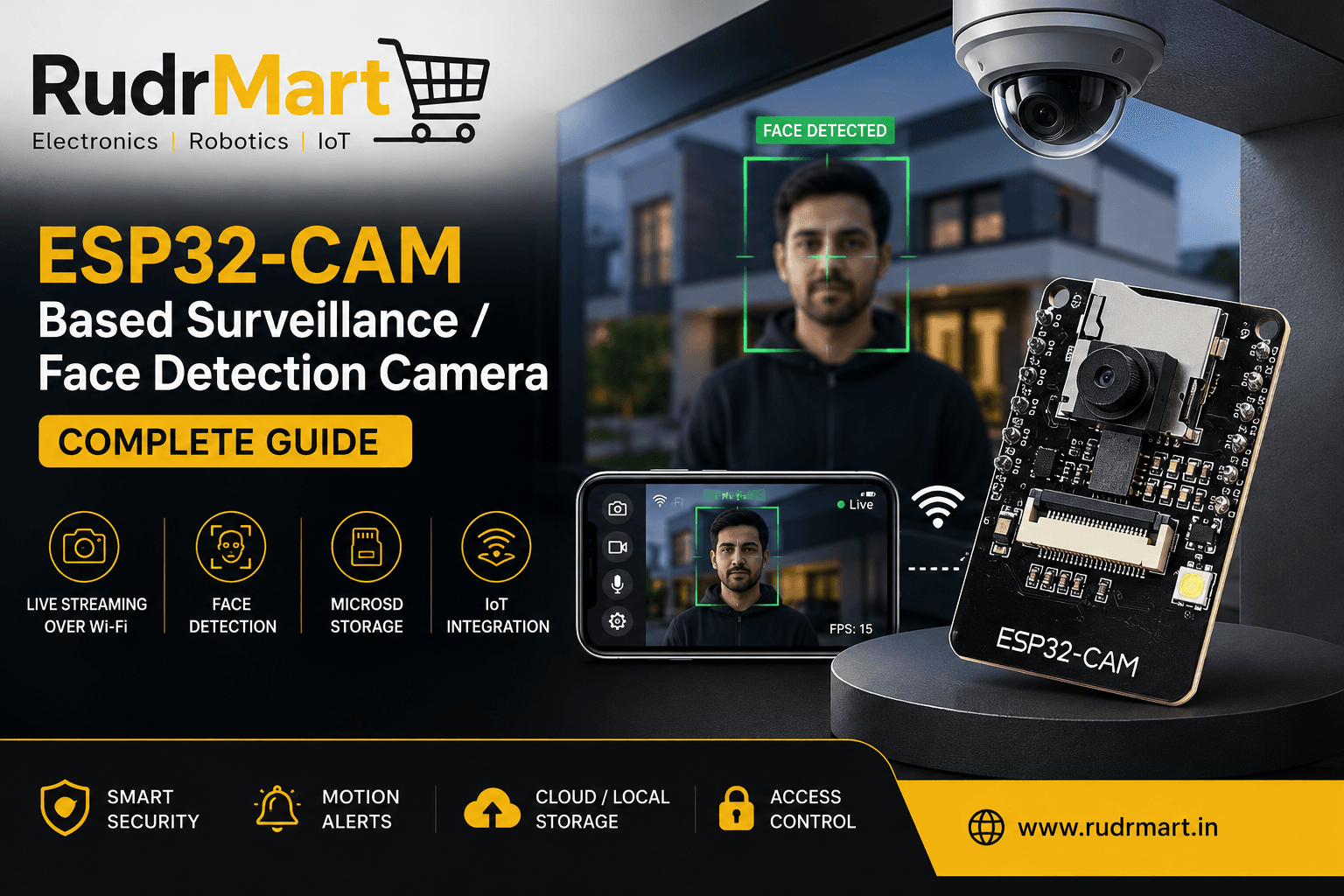
ESP32-CAM Based Surveillance Camera is one of the most affordable and powerful IoT security solutions available today. Combining Wi-Fi connectivity, an OV2640 camera module, and built-in face detection capabilities, it enables developers, students, and hobbyists to build intelligent surveillance systems with minimal hardware. In this complete guide, you’ll learn how the ESP32-CAM works, its features, applications, advantages, and how to build your own smart surveillance camera.
Powered by Espressif’s ESP32 processor and the OV2640 camera module, the ESP32-CAM combines Wi-Fi, Bluetooth, onboard image processing, and AI-enabled face detection into a compact development board. It enables developers, students, startups, and businesses to build intelligent surveillance systems without requiring high-end hardware.
This article explores the ESP32-CAM architecture, working principle, features, applications, advantages, limitations, and how you can build your own smart surveillance solution.
What is an ESP32-CAM?
The ESP32-CAM is a compact development board built around the ESP32-S chip that integrates:
- Dual-Core ESP32 Processor
- OV2640 2MP Camera Module
- Wi-Fi (802.11 b/g/n)
- Bluetooth BLE
- MicroSD Card Slot
- Multiple GPIO Pins
- External PSRAM (typically 4MB)
Unlike conventional microcontrollers, the ESP32-CAM combines wireless communication and image processing capabilities, making it ideal for IoT vision applications.
It supports:
- Live video streaming
- Face detection
- Face recognition
- Motion-triggered image capture
- Remote monitoring
- Smart home automation
Face detection runs directly on the device using Espressif’s lightweight vision libraries, allowing many applications to operate without cloud processing.
Key Features of ESP32-CAM
The ESP32-CAM Based Surveillance Camera supports live video streaming, face detection, image capture, MicroSD storage, and wireless communication without requiring expensive hardware.
1. Built-in Wi-Fi Connectivity
The ESP32-CAM can stream video over Wi-Fi and communicate with:
- Mobile applications
- Web browsers
- Cloud servers
- MQTT brokers
- IoT dashboards
2. Face Detection
The onboard AI algorithms detect human faces in real time by drawing bounding boxes around detected faces.
Face detection works efficiently at lower resolutions such as QVGA and VGA, which balance performance and memory usage.
3. Face Recognition
Unlike simple detection, face recognition allows the system to:
- Register known users
- Compare captured faces
- Identify authorized individuals
- Trigger customized actions
Examples include:
- Smart door locks
- Attendance systems
- Access control
- Visitor logging
4. Live Video Streaming
ESP32-CAM hosts an embedded web server that provides:
- Live camera feed
- Camera settings
- Brightness adjustment
- Resolution control
- Face detection controls
Users only need a browser to access the camera.
5. MicroSD Card Support
Images and videos can be stored locally for:
- Evidence collection
- Time-lapse recording
- Motion-triggered snapshots
- Offline monitoring
6. GPIO Expansion
Additional sensors can easily be connected:
- PIR Motion Sensor
- IR Sensor
- Door Sensor
- Temperature Sensor
- Smoke Sensor
- Relay Modules
- Servo Motors
- Alarm Buzzers
Technical Specifications
| Feature | Specification |
|---|---|
| Processor | ESP32 Dual-Core 240 MHz |
| Camera | OV2640 (2 MP) |
| RAM | 520 KB SRAM |
| External Memory | 4 MB PSRAM |
| Wireless | Wi-Fi + Bluetooth BLE |
| Storage | MicroSD Card |
| Resolution | Up to UXGA (1600×1200) |
| Operating Voltage | 5V |
| GPIO | Multiple programmable pins |
How an ESP32-CAM Surveillance System Works
The surveillance system follows these steps:
Step 1: Image Capture
The OV2640 camera continuously captures video frames.
Step 2: Image Processing
The ESP32 processor analyzes each frame.
Step 3: Face Detection
AI algorithms identify faces within the captured frame.
Step 4: Recognition (Optional)
If enabled:
- Compare with enrolled faces
- Identify known users
Step 5: Action Trigger
The system can:
- Save an image
- Activate a relay
- Unlock a door
- Send alerts
- Record attendance
- Upload images to cloud storage
This processing pipeline is handled on the ESP32 using onboard resources, with optional cloud integration for advanced workflows.
Components Required
A basic surveillance project requires:
- ESP32-CAM Module
- FTDI USB Programmer
- OV2640 Camera
- 5V Power Supply
- Jumper Wires
Optional components:
- PIR Motion Sensor
- Relay Module
- Servo Motor
- MicroSD Card
- Buzzer
- LED Indicators
- Door Lock
- RTC Module
Software Requirements
Development can be done using:
- Arduino IDE
- ESP32 Board Package
- CameraWebServer Example
- ESP-WHO Library
- Wi-Fi Network
Optional integrations:
- MQTT
- Firebase
- Telegram Bot
- Node-RED
- Home Assistant
- Blynk
Face Detection vs Face Recognition
| Face Detection | Face Recognition |
|---|---|
| Detects if a face exists | Identifies whose face it is |
| No enrollment required | Requires face registration |
| Faster | Slightly slower |
| Lower memory usage | Higher memory usage |
| Suitable for surveillance | Suitable for access control |
Applications
An ESP32-CAM Based Surveillance Camera can be used for smart home security, office attendance systems, access control, visitor management, industrial surveillance, and warehouse monitoring.
1. Smart Home Security
- Visitor monitoring
- Intruder detection
- Door surveillance
2. Office Attendance System
Employees can be automatically recognized without RFID cards.
3. Smart Door Lock
Recognized users can unlock doors automatically.
4. Industrial Monitoring
Monitor:
- Entry points
- Equipment rooms
- Restricted areas
5. Retail Security
Detect unauthorized access after business hours.
6. Classroom Attendance
Automatically identify students entering classrooms.
7. Baby Monitoring
Parents can remotely view live video through Wi-Fi.
8. Wildlife Observation
Battery-powered deployment enables remote monitoring of animals.
9. Warehouse Surveillance
Monitor:
- Inventory movement
- Restricted storage
- Loading docks
Advantages
Compared with traditional CCTV systems, an ESP32-CAM Based Surveillance Camera is smaller, more affordable, consumes less power, and is easy to integrate with IoT platforms.
- Very low cost
- Compact size
- Built-in Wi-Fi
- Bluetooth support
- Face detection capability
- Local processing
- Easy Arduino programming
- Open-source ecosystem
- Supports IoT integration
- Expandable with sensors
Limitations
- Limited RAM compared to Raspberry Pi
- Face recognition performance depends on lighting and resolution
- Best performance at lower resolutions
- Not suitable for heavy AI workloads
- Requires stable power supply for reliable camera operation
Best Practices
- Use adequate lighting.
- Mount the camera securely.
- Keep firmware updated.
- Store important images on a MicroSD card.
- Use WPA2-secured Wi-Fi.
- Add motion detection to reduce unnecessary recording.
- Enable HTTPS or authentication for remote access when exposing the device online.
Future Enhancements
Future ESP32-CAM projects can include:
- Cloud storage
- AI object detection
- Number plate recognition
- Voice assistant integration
- Mobile notifications
- Telegram alerts
- Email alerts
- Edge AI analytics
- Smart city surveillance
- Industrial safety monitoring
Why Choose ESP32-CAM for IoT Surveillance?
The ESP32-CAM Based Surveillance Camera combines Wi-Fi connectivity, a built-in camera module, and edge AI capabilities, making it an excellent choice for home security, industrial monitoring, and IoT projects.
Compared with traditional CCTV systems, the ESP32-CAM provides an affordable and flexible platform for IoT-based surveillance. It is suitable for prototyping and many practical deployments where low power consumption, wireless connectivity, and basic edge AI capabilities are sufficient. Its built-in web server, support for face detection and recognition, and compatibility with Arduino IDE make it one of the most popular embedded vision platforms for students, makers, and engineers.
Conclusion
The ESP32-CAM Based Surveillance/Face Detection Camera is an excellent platform for building intelligent, low-cost security systems. Combining Wi-Fi connectivity, onboard image processing, face detection, and IoT integration, it enables applications ranging from home surveillance and office attendance to industrial monitoring and smart access control.
Whether you’re a student, hobbyist, startup, or professional developer, the ESP32-CAM offers an accessible way to experiment with edge AI and embedded vision while keeping costs low. With the right sensors and software, it can be expanded into a powerful smart surveillance solution tailored to your specific needs.
Frequently Asked Questions (FAQs)
1. Does the ESP32-CAM support face recognition?
Yes. Besides face detection, it also supports face recognition by enrolling known faces and matching them during operation.
2. Can the ESP32-CAM stream live video over Wi-Fi?
Yes. It includes a built-in web server that allows live video streaming through any web browser on the same network.
3. Does the ESP32-CAM require cloud services?
No. Face detection and basic processing can run locally on the device, though cloud services can be added for storage or notifications.
4. Can I save captured images?
Yes. Images and videos can be stored on a MicroSD card or uploaded to cloud storage.
5. What programming software is used?
Most developers use the Arduino IDE with Espressif’s ESP32 board package, though PlatformIO and ESP-IDF are also supported.
6. Is the ESP32-CAM suitable for industrial projects?
Yes. It is suitable for cost-effective monitoring, access control, and IoT surveillance applications, although more demanding AI workloads may require more powerful edge-computing hardware.
7. Can I connect motion sensors to the ESP32-CAM?
Yes. PIR sensors, IR sensors, relays, alarms, and other peripherals can be integrated through the available GPIO pins.
AI CameraEmbedded SystemsESP32ESP32-CAMFace RecognitionHome AutomationMicrocontroller ProjectsRoboticsrudrmartSurveillance Camera
