- Empty cart.
- Continue Shopping
What is ESP32? A Beginner’s Guide to WiFi & Bluetooth Microcontrollers
- Posted on
 Deepak Joshi
- 0
- Categories: Embedded Systems

Introduction
The ESP32 Microcontroller is one of the most popular development platforms for IoT and embedded systems. With built-in WiFi and Bluetooth connectivity, the ESP32 Microcontroller allows developers to create smart devices, wireless sensor networks, and automation systems with ease.
Whether you’re building a smart home system, wireless sensor network, IoT device, or robotics project, the ESP32 offers a powerful and affordable solution. In this beginner’s guide, we’ll explore what the ESP32 is, its features, architecture, applications, advantages, and how to get started with programming it.
What is ESP32?
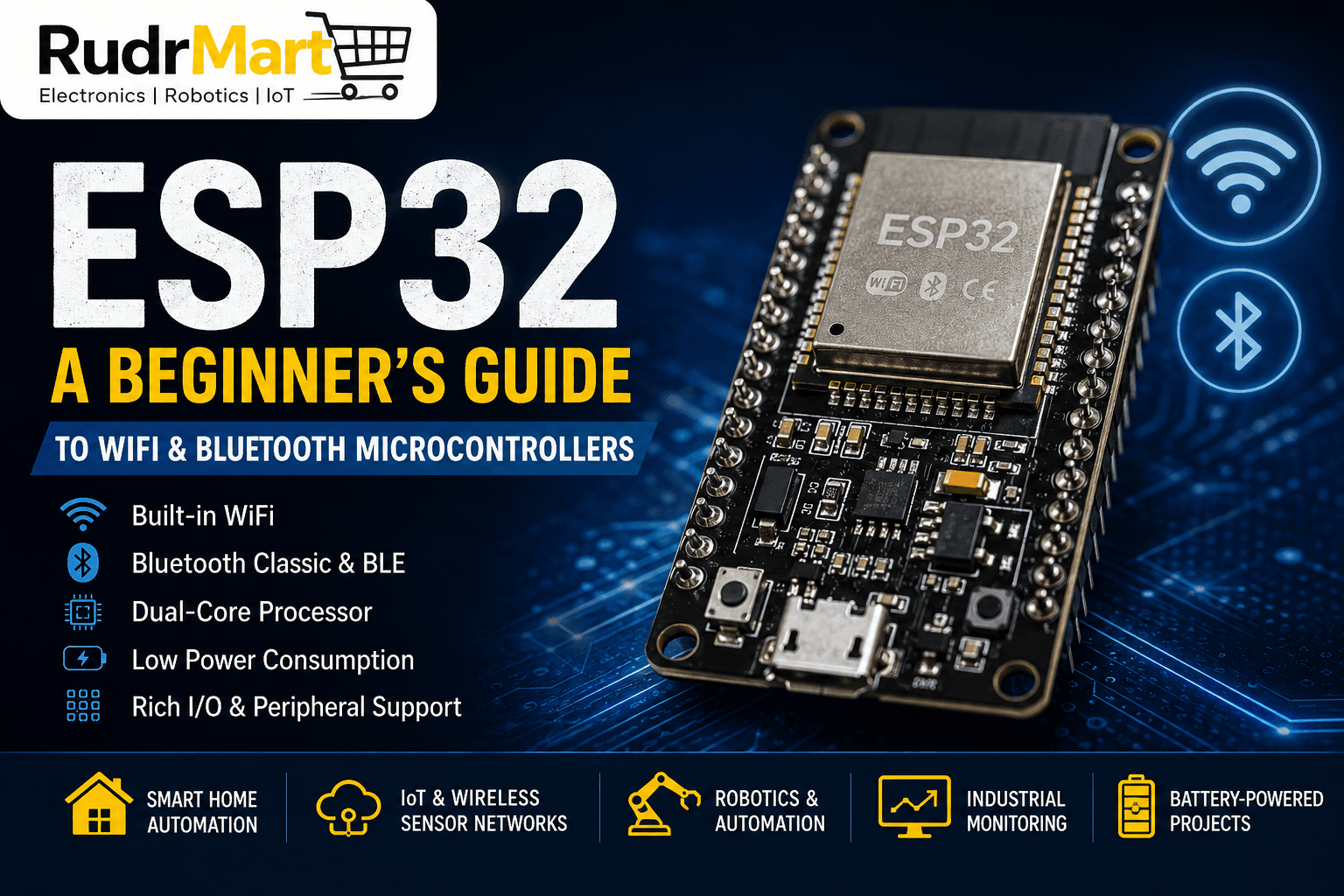
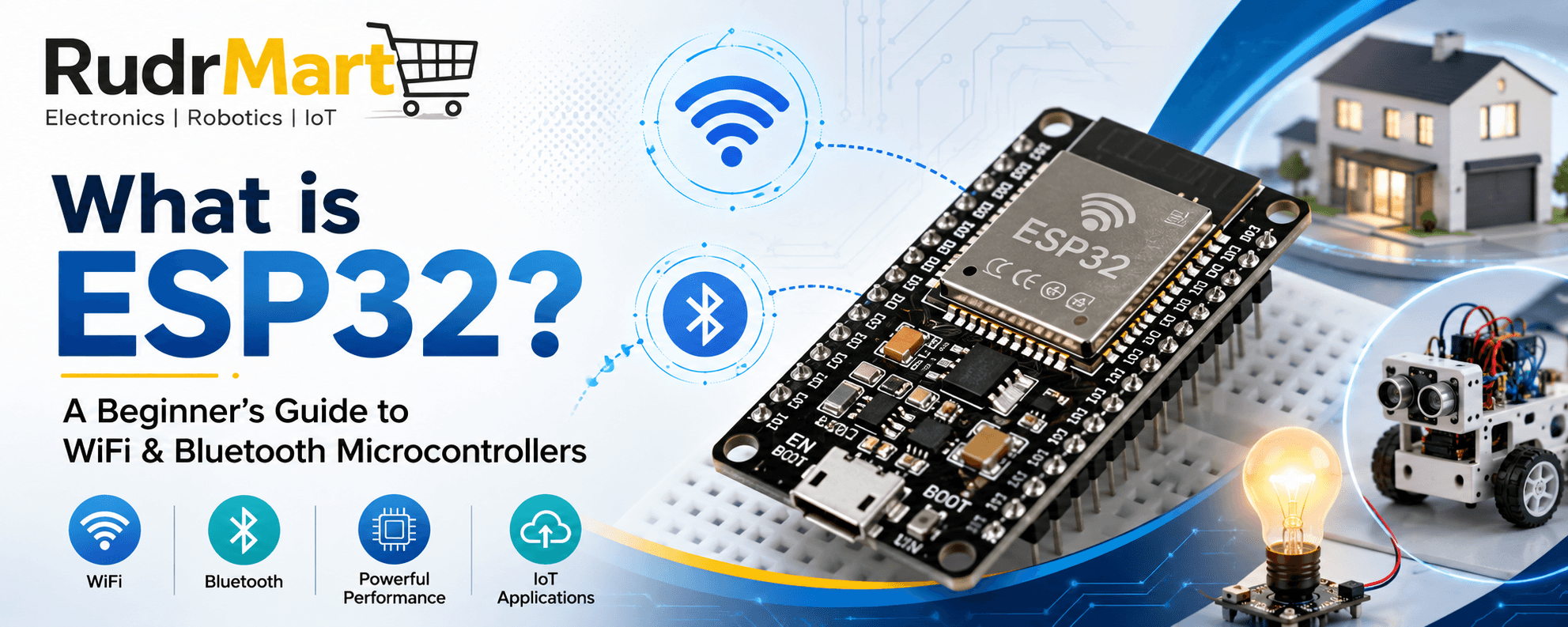
The ESP32 is a low-cost, low-power microcontroller developed by Espressif Systems. It integrates WiFi and Bluetooth connectivity into a single chip, making it a versatile platform for IoT and embedded applications.
Introduced as the successor to the popular ESP8266, the ESP32 provides significantly improved processing power, more GPIO pins, enhanced security features, and support for both Bluetooth Classic and Bluetooth Low Energy (BLE).
The microcontroller is commonly available on development boards such as the ESP32 DevKit, which simplifies programming and prototyping.
Why Choose an ESP32 Microcontroller?
The ESP32 Microcontroller offers an excellent balance of performance, connectivity, and affordability. Whether you are a beginner learning electronics or an engineer developing commercial IoT products, the ESP32 Microcontroller provides the tools needed for rapid development.
Key Features of ESP32
The popularity of the ESP32 stems from its impressive feature set.
1. Built-in WiFi Connectivity
ESP32 includes integrated 2.4 GHz WiFi, allowing devices to:
- Connect to home or office networks
- Communicate with cloud platforms
- Host web servers
- Enable remote monitoring and control
This eliminates the need for external WiFi modules.
2. Bluetooth Support
Unlike many microcontrollers, ESP32 supports:
- Bluetooth Classic
- Bluetooth Low Energy (BLE)
This capability enables wireless communication with smartphones, tablets, and other Bluetooth-enabled devices.
3. Dual-Core Processor
Most ESP32 variants feature a dual-core processor running up to 240 MHz.
Benefits include:
- Faster processing
- Multitasking capabilities
- Better performance for complex applications
4. Multiple GPIO Pins
ESP32 offers numerous General Purpose Input/Output (GPIO) pins for interfacing with:
- Sensors
- Displays
- Motors
- Relays
- LEDs
This flexibility makes it suitable for a wide range of electronics projects.
5. Low Power Consumption
ESP32 includes advanced power-saving modes such as:
- Light Sleep
- Deep Sleep
- Hibernation
These features make it ideal for battery-powered IoT devices.
6. Rich Peripheral Support
The ESP32 supports various communication protocols including:
- UART
- SPI
- I2C
- CAN
- PWM
- ADC
- DAC
As a result, it can connect with a large variety of electronic components and modules.
ESP32 Architecture Overview
Understanding the architecture helps beginners appreciate the capabilities of the ESP32.
Core Components
An ESP32 chip typically contains:
- Dual-core Xtensa LX6 processor
- Integrated WiFi transceiver
- Bluetooth controller
- SRAM memory
- Flash memory support
- Security hardware
- GPIO subsystem
- Analog and digital peripherals
The combination of processing power and wireless connectivity makes the ESP32 a complete IoT solution on a single chip.
ESP32 Pin Configuration
A typical ESP32 development board includes:
- Digital I/O Pins
- Analog Input Pins
- PWM Output Pins
- SPI Interface Pins
- I2C Interface Pins
- UART Communication Pins
- Power Pins (3.3V and GND)
Before connecting peripherals, always consult the board’s pinout diagram to ensure proper usage of GPIO pins.
Why is ESP32 Popular for IoT Projects?
The Internet of Things relies on devices that can sense, process, and communicate data. ESP32 excels in all three areas.
Connectivity
Built-in WiFi and Bluetooth simplify communication.
Processing Power
The dual-core processor can handle data collection, processing, and transmission simultaneously.
Cost-Effectiveness
ESP32 development boards are affordable, making them accessible to beginners and professionals alike.
Extensive Community Support
Thousands of tutorials, libraries, and open-source projects are available online, making learning easier.
Applications of ESP32 Microcontroller
The ESP32 Microcontroller is widely used in smart home automation, industrial monitoring, robotics, wearable technology, and wireless communication systems. Thanks to its integrated wireless features, the ESP32 Microcontroller reduces hardware complexity while improving project flexibility.
Smart Home Automation
Examples include:
- Smart lighting systems
- Smart switches
- Security monitoring
- Energy management systems
Wireless Sensor Networks
ESP32 can collect data from:
- Temperature sensors
- Humidity sensors
- Pressure sensors
- Motion detectors
The information can then be transmitted over WiFi or Bluetooth.
Robotics
The processing power and connectivity make ESP32 suitable for:
- Mobile robots
- Robotic arms
- Autonomous vehicles
- Remote-controlled systems
Industrial Monitoring
Industries use ESP32-based solutions for:
- Equipment monitoring
- Predictive maintenance
- Data logging
- Process automation
Wearable Devices
Its low power consumption supports applications such as:
- Fitness trackers
- Health monitoring devices
- Smart wearables
Advantages of Using ESP32
Several factors make ESP32 a preferred microcontroller platform.
Integrated Wireless Communication
No external WiFi or Bluetooth module is required.
High Performance
The dual-core architecture offers superior processing capabilities compared to many entry-level microcontrollers.
Low Cost
ESP32 provides advanced functionality at a budget-friendly price.
Energy Efficient
Deep sleep modes extend battery life significantly.
Flexible Development
It supports multiple programming environments and languages.
ESP32 vs ESP8266
Many beginners wonder about the difference between ESP32 and ESP8266.
| Feature | ESP32 | ESP8266 |
|---|---|---|
| WiFi | Yes | Yes |
| Bluetooth | Yes | No |
| CPU Cores | Dual Core | Single Core |
| Clock Speed | Up to 240 MHz | Up to 160 MHz |
| GPIO Pins | More | Fewer |
| Security Features | Advanced | Basic |
| Performance | Higher | Moderate |
While the ESP8266 remains useful for simple projects, ESP32 is generally the better choice for modern IoT applications.
How to Program an ESP32
Programming ESP32 is straightforward, even for beginners.
Using Arduino IDE
The most popular option is the Arduino IDE.
Steps include:
- Install Arduino IDE.
- Add ESP32 board support.
- Connect the ESP32 via USB.
- Select the correct board and COM port.
- Upload your code.
Using PlatformIO
PlatformIO provides advanced development features for professional users.
Using MicroPython
ESP32 can also run MicroPython, allowing developers to program using Python syntax.
Simple ESP32 Project Ideas for Beginners
If you’re just getting started, consider these beginner-friendly projects:
LED Blink Project
Learn basic GPIO control.
WiFi Weather Station
Display weather information retrieved from the internet.
Bluetooth Device Controller
Control LEDs and appliances using a smartphone.
Smart Temperature Monitor
Monitor and upload temperature data to the cloud.
IoT Home Automation System
Control lights and appliances remotely through a mobile app.
Best Practices When Working with ESP32
To ensure successful project development:
- Use a stable 3.3V power supply.
- Avoid drawing excessive current from GPIO pins.
- Enable sleep modes for battery-powered projects.
- Protect circuits from voltage spikes.
- Keep firmware updated.
- Test WiFi signal strength during deployment.
Following these practices improves reliability and performance.
Future of ESP32 in IoT Development
As IoT adoption continues to grow, ESP32 remains one of the leading microcontroller platforms. Its balance of performance, wireless connectivity, affordability, and ease of development makes it suitable for educational projects, commercial products, and industrial applications.
New variants continue to introduce improved performance, enhanced security, AI capabilities, and additional connectivity options, ensuring the ESP32 remains relevant for future embedded system designs.
Conclusion
The ESP32 Microcontroller has become a preferred choice for developers worldwide because of its powerful processing capabilities, integrated WiFi and Bluetooth support, and low cost. Whether you’re building a simple sensor project or a complex IoT solution, the ESP32 Microcontroller provides a reliable and scalable platform for innovation.
For beginners, ESP32 offers an excellent starting point due to its affordability, extensive community support, and easy programming options. Whether you’re experimenting with electronics for the first time or developing advanced IoT solutions, learning ESP32 is a valuable step toward mastering modern embedded systems.
Frequently Asked Questions (FAQs)
1. What is ESP32 used for?
ESP32 is commonly used for IoT devices, smart home automation, robotics, industrial monitoring, wireless sensors, and connected embedded systems.
2. Does ESP32 have built-in WiFi?
Yes, ESP32 includes integrated 2.4 GHz WiFi connectivity, eliminating the need for an external WiFi module.
3. Does ESP32 support Bluetooth?
Yes, ESP32 supports both Bluetooth Classic and Bluetooth Low Energy (BLE).
4. Is ESP32 better than ESP8266?
For most modern applications, ESP32 is superior because it offers Bluetooth support, higher performance, more GPIO pins, and enhanced security features.
5. Can beginners learn ESP32 easily?
Yes. ESP32 is beginner-friendly and supported by extensive documentation, tutorials, and development tools like Arduino IDE.
6. Which programming language is used for ESP32?
ESP32 can be programmed using C++, Arduino language, MicroPython, and other supported frameworks.
7. Is ESP32 suitable for industrial applications?
Yes. ESP32 is widely used in industrial monitoring, automation, data acquisition, and IoT-based control systems.
8. What makes the ESP32 Microcontroller popular?
The ESP32 Microcontroller is popular because it combines WiFi, Bluetooth, high processing power, low energy consumption, and extensive GPIO support in a single affordable device.