- Empty cart.
- Continue Shopping
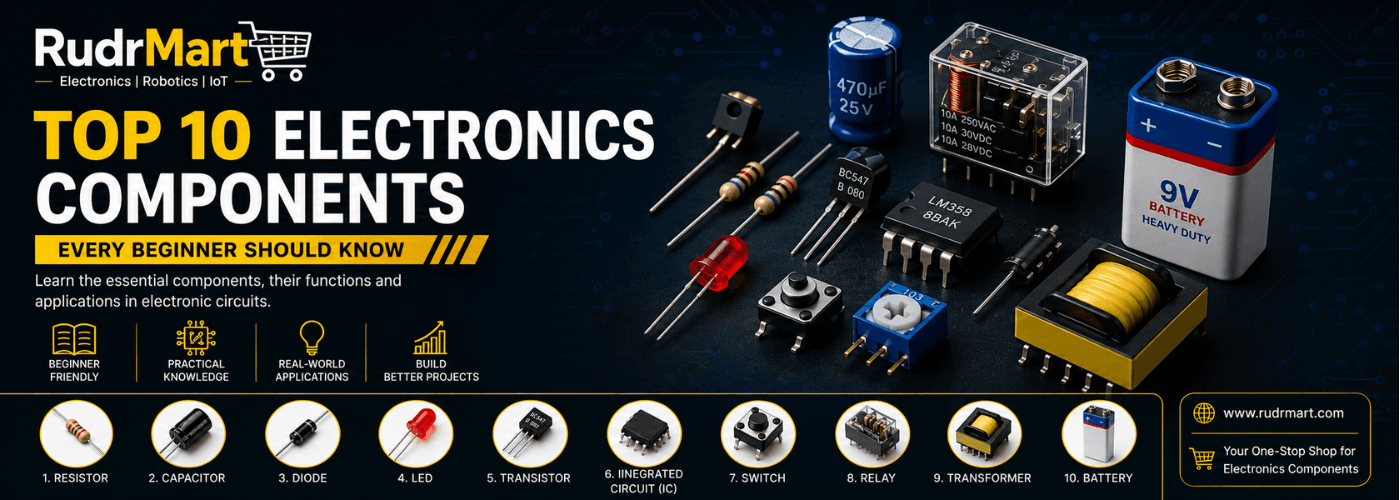
Top 10 Electronics Components Every Beginner Should Know
- Posted on
 Deepak Joshi
- 0
- Categories: Technology,Battery,Breadboard Projects,Capacitor,Circuit Design,Diode,Electronic Parts,Electronics,Electronics for Beginners,Electronics Learning,Integrated Circuit (IC),LED,Relay,Resistor,Transistor

Introduction
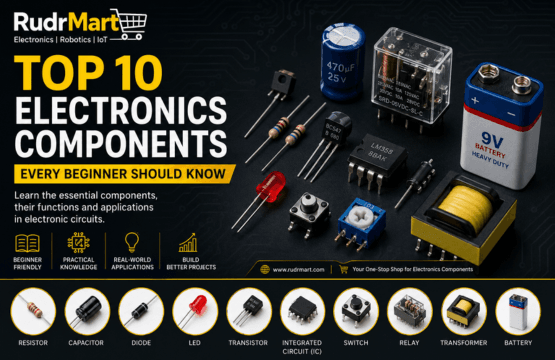
Electronics Components for Beginners are the foundation of every electronic circuit and device. Whether you want to build DIY projects, learn robotics, repair gadgets, or start a career in electronics, understanding the most important electronics components is essential. This guide covers the top electronics components for beginners and explains their functions, applications, and importance in modern circuits.
Why Learning Electronics Components for Beginners Is Important
Understanding electronics components for beginners helps build a strong foundation in circuit design and troubleshooting. Before working with microcontrollers, sensors, or advanced electronics systems, beginners should become familiar with the basic components used in almost every circuit.
What Are Electronic Components?
Electronic components are the building blocks of electrical and electronic circuits. They control the flow of current, store energy, amplify signals, and perform various functions required for devices to operate correctly.
From simple LED projects to advanced automation systems, understanding these components is crucial for anyone entering the field of electronics.
1. Resistor
A resistor is one of the most commonly used electronic components. Its primary function is to limit or control the flow of electrical current within a circuit.
Common Applications:
- Current limiting for LEDs
- Voltage division
- Signal conditioning
- Circuit protection
Why Beginners Should Learn It:
Resistors are present in almost every electronic circuit. Learning resistor values, color codes, and power ratings forms the foundation of electronics.
2. Capacitor
Capacitors store electrical energy temporarily and release it when needed. They are widely used for filtering, smoothing, and timing applications.
Common Applications:
- Power supply filtering
- Noise reduction
- Signal coupling
- Timing circuits
Types of Capacitors:
- Ceramic Capacitors
- Electrolytic Capacitors
- Tantalum Capacitors
- Film Capacitors
Why Beginners Should Learn It:
Understanding capacitance and capacitor polarity helps prevent circuit failures and improves circuit performance.
3. Diode
A diode allows current to flow in only one direction and blocks it in the opposite direction.
Common Applications:
- Rectification
- Reverse polarity protection
- Voltage regulation
- Signal demodulation
Popular Types:
- Rectifier Diodes
- Zener Diodes
- Schottky Diodes
- Light Emitting Diodes (LEDs)
Why Beginners Should Learn It:
Diodes are critical for protecting circuits and converting AC power into DC power.
4. LED (Light Emitting Diode)
An LED is a semiconductor device that emits light when electrical current passes through it.
Common Applications:
- Indicators
- Displays
- Lighting systems
- Decorative electronics
Advantages:
- Low power consumption
- Long lifespan
- Compact size
- High efficiency
Why Beginners Should Learn It:
LED projects are often the first electronics experiments for beginners, making them an excellent learning tool.
5. Transistor
A transistor acts as an electronic switch or amplifier. It is one of the most important inventions in modern electronics.
Common Applications:
- Switching circuits
- Signal amplification
- Logic circuits
- Microcontroller interfaces
Common Types:
- Bipolar Junction Transistor (BJT)
- MOSFET
Why Beginners Should Learn It:
Transistors form the foundation of digital electronics, computers, and automation systems.
6. Integrated Circuit (IC)
An Integrated Circuit combines multiple electronic components such as resistors, transistors, and capacitors onto a single chip.
Common Applications:
- Timers
- Amplifiers
- Microprocessors
- Memory devices
Popular Beginner ICs:
- 555 Timer IC
- LM358 Operational Amplifier
- 74 Series Logic ICs
Why Beginners Should Learn It:
ICs simplify circuit design and introduce learners to advanced electronics concepts.
7. Switch
A switch is used to open or close an electrical circuit, allowing users to control current flow manually.
Common Applications:
- Power control
- User interfaces
- Circuit selection
- Safety systems
Types of Switches:
- Push Button Switch
- Toggle Switch
- Slide Switch
- Rotary Switch
Why Beginners Should Learn It:
Switches are simple yet essential components found in almost every electronic device.
8. Relay
A relay is an electrically operated switch that allows low-power circuits to control high-power devices safely.
Common Applications:
- Home automation
- Industrial control systems
- Motor control
- Lighting systems
Advantages:
- Electrical isolation
- High switching capacity
- Reliable operation
Why Beginners Should Learn It:
Relays help beginners understand how electronic circuits interact with real-world electrical loads.v
9. Transformer
A transformer transfers electrical energy between circuits through electromagnetic induction.
Common Applications:
- Power supplies
- Voltage conversion
- Isolation circuits
- Battery chargers
Functions:
- Step-Up Voltage
- Step-Down Voltage
- Electrical Isolation
Why Beginners Should Learn It:
Transformers play a key role in power distribution and electronic equipment operation.
10. Battery
A battery provides the electrical energy needed to power electronic circuits and devices.
Common Applications:
- Portable electronics
- Remote controls
- IoT devices
- Backup power systems
Common Battery Types:
- Alkaline Batteries
- Lithium-Ion Batteries
- Nickel-Metal Hydride Batteries
- Coin Cell Batteries
Why Beginners Should Learn It:
Every electronics project requires a reliable power source, making batteries an essential component to understand.
How These Components Work Together
A simple electronics circuit may include:
- A battery as the power source
- A switch for control
- A resistor to limit current
- An LED for output
- A transistor for switching
- A capacitor for filtering
By combining these components, beginners can create functional circuits and gradually move toward more advanced projects.
Tips for Beginners Learning Electronics
Start with Basic Projects
Begin with LED circuits, battery-powered projects, and simple sensors.
Learn Circuit Symbols
Understanding schematic diagrams makes it easier to build and troubleshoot circuits.
Use a Breadboard
Breadboards allow circuit prototyping without soldering.
Practice Reading Datasheets
Datasheets provide valuable information about component specifications and operating limits.
Follow Safety Precautions
Always verify voltage ratings and component polarity before powering a circuit.
Mastering Electronics Components for Beginners
Learning about electronics components for beginners allows hobbyists and students to confidently create projects and understand how electronic devices function. From simple LED circuits to advanced automation systems, these components form the backbone of modern electronics.
Conclusion
Understanding electronics components for beginners is one of the most important steps toward learning electronics successfully. By mastering these electronics components for beginners, you can develop practical skills, build innovative projects, and gain confidence in designing electronic circuits.Components such as resistors, capacitors, diodes, LEDs, transistors, ICs, switches, relays, transformers, and batteries are the essential building blocks found in countless electronic devices.
By understanding how these components function and interact within a circuit, beginners can confidently explore electronics, build practical projects, and advance toward more complex designs.
For additional beginner tutorials, visit SparkFun Learn
Frequently Asked Questions (FAQs)
1. What are the most important electronics components for beginners?
Resistors, capacitors, diodes, LEDs, transistors, ICs, switches, relays, transformers, and batteries are among the most important components beginners should learn.
2. Why are resistors used in electronic circuits?
Resistors limit current flow, protect components, and help control voltage levels within a circuit.
3. What is the function of a capacitor?
Capacitors store electrical energy temporarily and are used for filtering, smoothing, and timing applications.
4. What is the difference between a diode and an LED?
A diode allows current to flow in one direction, while an LED is a type of diode that emits light when current passes through it.
5. Why are transistors important in electronics?
Transistors act as switches and amplifiers, making them essential for digital circuits, computers, and automation systems.
6. What is an Integrated Circuit (IC)?
An IC is a compact chip containing multiple electronic components that perform specific electronic functions.
7. How can beginners start learning electronics?
Beginners can start by understanding basic components, building simple circuits on a breadboard, and practicing with beginner-friendly electronics projects.