- Empty cart.
- Continue Shopping
Rechargeable vs Non-Rechargeable Batteries for Electronics Projects: Pros, Cons, and Best Uses
- Posted on
 Deepak Joshi
- 0
- Categories: Electronics

Introduction
Batteries are an essential part of many electronics projects. Whether you are building an Arduino-compatible prototype, IoT device, robot, sensor system, remote controller, LED project, or portable electronic circuit, choosing the right battery can directly affect performance, operating time, cost, and reliability.
One common question beginners face is: Should I use rechargeable or non-rechargeable batteries for my electronics project?
Both options have advantages. Rechargeable batteries can be reused many times and are well suited to frequently operated devices. In contrast, non-rechargeable batteries are convenient for projects that consume little power or remain unused for long periods.
In this guide, we compare rechargeable vs non-rechargeable batteries for electronics projects, explain their advantages and disadvantages, and help you choose the right battery for different applications.
What Is a Rechargeable Battery?
A rechargeable battery, also known as a secondary battery, is designed to be charged and used repeatedly.
Instead of replacing the battery after its stored energy has been consumed, you connect it to a compatible charger. The charging process restores electrical energy through reversible electrochemical reactions.
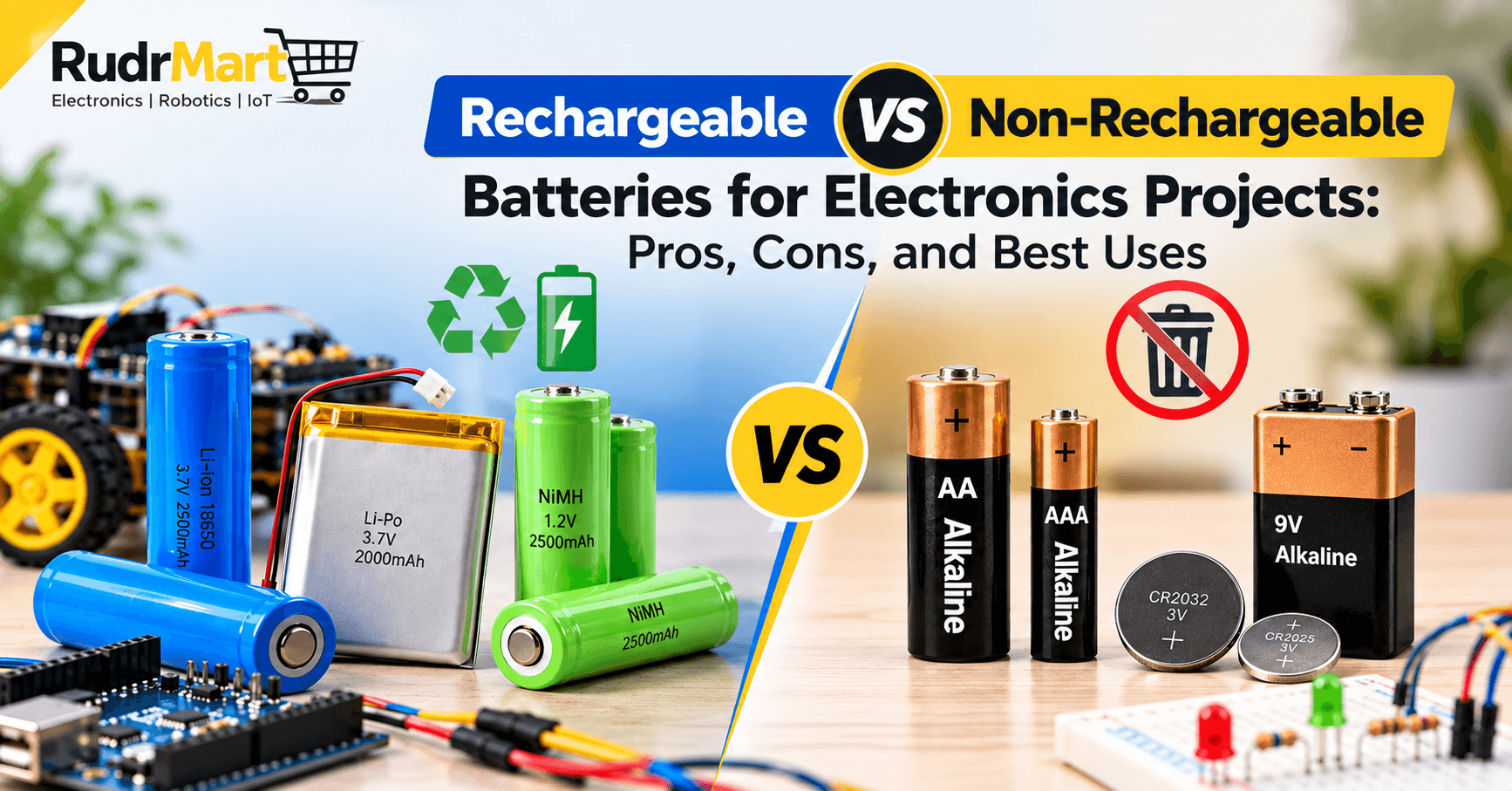
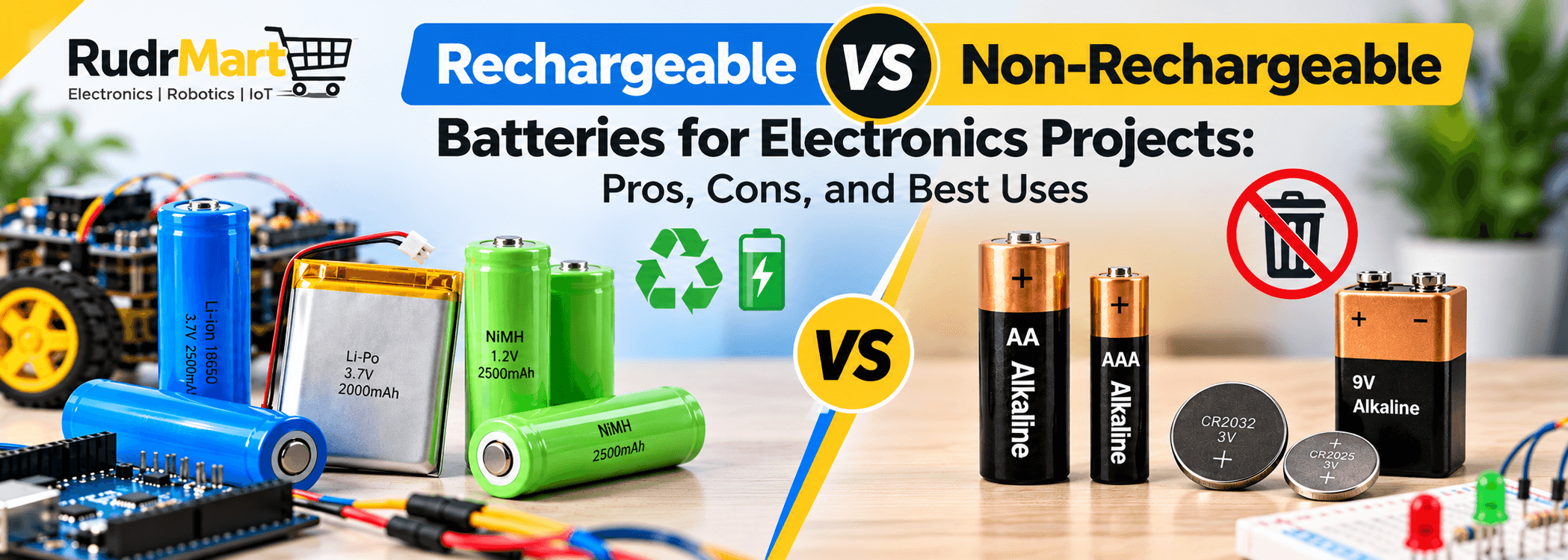
Common rechargeable battery types include:
- Lithium-ion (Li-ion)
- Lithium-polymer (Li-Po)
- Nickel-metal hydride (NiMH)
- Nickel-cadmium (NiCd)
- Lead-acid batteries
Among these, Li-ion, Li-Po, and NiMH batteries are commonly encountered in electronics, robotics, portable devices, and DIY projects.
Advantages of Rechargeable Batteries
1. Reusable
The biggest advantage is that rechargeable batteries can go through many charge and discharge cycles when they are used and charged correctly.
2. Better for frequently used projects
If your electronic device operates every day, replacing disposable batteries repeatedly can become inconvenient and expensive. A rechargeable power source is often more practical.
3. Suitable for portable electronics
Rechargeable batteries are widely used in portable electronic equipment such as robots, handheld devices, wireless systems, and IoT prototypes.
4. Potentially lower long-term battery cost
Although the initial purchase price can be higher, repeated use can reduce the cost per operating cycle.
5. Less frequent battery disposal
Reusing a battery reduces the number of individual cells that need to be discarded compared with repeatedly using single-use batteries.
Disadvantages of Rechargeable Batteries
Rechargeable batteries also have some limitations.
First, they require a suitable charging system. Lithium-based batteries, in particular, should be charged using circuitry designed for the specific battery chemistry and configuration.
Second, rechargeable batteries gradually lose usable capacity as they age and cycle.
Finally, some battery chemistries require protection against conditions such as overcharging, excessive discharge, overcurrent, or short circuits.
Therefore, battery selection should consider not only voltage and capacity but also charging and protection requirements.
What Is a Non-Rechargeable Battery?
A non-rechargeable battery is a primary battery designed mainly for single-use operation.
Once most of its usable stored energy has been consumed, the battery is normally replaced rather than recharged.
Common examples include:
- Alkaline AA batteries
- Alkaline AAA batteries
- Zinc-carbon batteries
- Primary lithium coin cells
- Other primary lithium batteries
These batteries are commonly found in remote controls, clocks, toys, calculators, sensors, small test circuits, and low-power electronic devices.
Advantages of Non-Rechargeable Batteries
1. Simple to use
You generally do not need to design a charging circuit. Insert the correct batteries into a suitable holder and connect the supply according to your circuit requirements.
2. Convenient for low-power applications
Primary batteries can be useful when a circuit consumes very little current and operates only occasionally.
3. Good storage characteristics
Many primary battery chemistries have relatively low self-discharge, making them useful for devices that may remain stored or inactive for extended periods.
4. Easy availability
AA, AAA, 9V, and coin-cell batteries are widely available.
5. Useful for simple prototypes
For basic experiments and temporary prototypes, replaceable batteries can provide a straightforward power source.
Disadvantages of Non-Rechargeable Batteries
The main disadvantage is repeated replacement.
If your project consumes significant power or operates frequently, disposable batteries can require frequent replacement and increase long-term operating costs.
They also create more battery waste when used regularly.
Most importantly, do not attempt to recharge a battery unless the manufacturer specifically identifies it as rechargeable. Trying to recharge a primary battery can cause leakage, overheating, rupture, or other hazards.
Rechargeable vs Non-Rechargeable Batteries: Quick Comparison
| Feature | Rechargeable Batteries | Non-Rechargeable Batteries |
|---|---|---|
| Reusability | Can be recharged repeatedly | Normally single-use |
| Initial Cost | Usually higher | Usually lower |
| Long-Term Cost | Often better for frequent use | Can become expensive with frequent replacement |
| Charger Required | Yes | No |
| Best For | Frequently used projects | Low-power or occasional-use projects |
| Circuit Complexity | May require charging/protection circuitry | Usually simpler |
| Maintenance | Requires charging | Requires replacement |
| Common Types | Li-ion, Li-Po, NiMH | Alkaline, zinc-carbon, primary lithium |
| Typical Applications | Robots, IoT devices, portable electronics | Remotes, clocks, sensors, basic projects |
The better option therefore depends on how your electronics project will actually operate.
Rechargeable vs Non-Rechargeable Batteries: Which Is Better for Electronics Projects?
There is no single battery type that is best for every project.
Instead, consider the following factors.
1. How Often Will the Project Be Used?
For a frequently used project, a rechargeable battery is often more convenient because it can be recharged rather than continuously replaced.
For an occasional demonstration or simple experiment, disposable batteries may be sufficient.
2. How Much Current Does the Circuit Require?
Power consumption is extremely important.
Motors, servos, wireless modules, displays, relays, and high-power LEDs can consume considerably more current than a simple low-power sensor.
A battery must therefore be capable of supplying the required current safely.
Do not choose a battery based only on its voltage.
3. How Long Should the Project Run?
Battery capacity is commonly expressed in milliamp-hours (mAh) or amp-hours (Ah).
A simplified battery runtime estimate is:
Runtime (hours) ≈ Battery capacity (mAh) ÷ Average load current (mA)
For example, if a battery has a capacity of 2000 mAh and a circuit draws an average of 200 mA:
2000 ÷ 200 = 10 hours
However, this is only an ideal estimate.
Actual runtime may be lower because of battery chemistry, discharge rate, temperature, converter efficiency, voltage limits, battery age, and changing load conditions.
4. Does Your Project Need Charging While Installed?
Some portable devices are designed so the battery remains inside the enclosure.
In that situation, a properly designed rechargeable battery system can be more convenient because users can charge the device without repeatedly opening it.
However, the charging circuit must match the battery chemistry.
5. What Voltage Does Your Circuit Need?
Different batteries provide different nominal voltages.
For example:
- A typical alkaline AA cell is commonly rated around 1.5 V.
- A NiMH rechargeable cell is commonly rated around 1.2 V nominal.
- A single Li-ion cell is commonly around 3.6–3.7 V nominal.
- A single Li-ion cell can reach approximately 4.2 V when fully charged, depending on its chemistry and specification.
This difference matters.
Never assume that two batteries of similar physical size can be substituted directly.
Your microcontroller, sensors, motors, and other components must receive a voltage within their specified operating ranges.
Best Batteries for Arduino-Compatible Projects
For Arduino-compatible projects, the ideal battery depends on the board, peripherals, regulator, and required runtime.
For simple experiments, an AA battery pack can be convenient.
For portable rechargeable projects, suitable Li-ion or Li-Po battery systems may be used with correctly designed regulation, charging, and protection circuitry.
USB power banks can also be convenient for some 5V development-board projects.
However, always verify your specific board’s power-input specifications before connecting a battery.
Best Batteries for ESP32 and IoT Projects
ESP32-based projects often use Wi-Fi or Bluetooth. Wireless communication can create short periods of higher current consumption.
Therefore, the power source should be selected not only for capacity but also for its ability to handle the device’s current demand.
Rechargeable Li-ion or Li-Po systems are commonly considered for portable IoT projects. Low-power designs can further improve runtime by using techniques such as deep sleep when appropriate.
For stationary prototypes, a regulated USB power supply may sometimes be more practical than a battery.
Best Batteries for Robotics Projects
Robots usually have higher power requirements because they may include:
- DC motors
- Servo motors
- Motor drivers
- Microcontrollers
- Sensors
- Wireless communication modules
- Displays or LEDs
For this reason, rechargeable battery systems are often more practical for robots that are operated regularly.
Nevertheless, voltage, maximum current, capacity, battery protection, motor requirements, and charging method all need to be considered.
In some designs, it is also beneficial to manage motor power and logic power carefully to reduce electrical noise and voltage drops.
Best Batteries for Sensors and Low-Power Projects
A low-power sensor node may operate for weeks, months, or potentially longer depending on its design and duty cycle.
In these applications, primary batteries can sometimes be a practical choice because certain chemistries offer good storage characteristics and low self-discharge.
Rechargeable batteries can also work, particularly when the device can be recharged conveniently or uses energy harvesting such as solar charging.
The correct choice depends on the project’s average current, peak current, environmental conditions, maintenance schedule, and required operating life.
Li-ion vs NiMH vs Alkaline Batteries
Understanding the differences between common battery chemistries can make selection easier.
Li-ion Batteries
Lithium-ion batteries offer high energy density and are popular in portable electronics.
Best suited for:
- Portable electronics
- IoT devices
- Rechargeable prototypes
- Robotics
- Wireless projects
They require appropriate charging and protection.
NiMH Batteries
NiMH rechargeable cells are commonly available in familiar AA and AAA formats.
Best suited for:
- Toys
- Battery-powered experiments
- Devices designed for rechargeable AA/AAA cells
- Educational projects
Their nominal cell voltage is generally lower than that of standard alkaline cells, so circuit compatibility should be checked.
Alkaline Batteries
Alkaline batteries are inexpensive, widely available, and simple to use.
Best suited for:
- Remote controls
- Clocks
- Basic electronics experiments
- Low-power sensors
- Occasional-use devices
For high-consumption projects, however, repeatedly replacing alkaline batteries may be less economical than using an appropriate rechargeable system.
When Should You Choose a Rechargeable Battery?
A rechargeable battery may be a good choice when:
- Your project is used frequently.
- The device is portable.
- Battery replacement would be inconvenient.
- The circuit has moderate or high energy requirements.
- You are building a robot or portable IoT device.
- You can incorporate a suitable charging and protection system.
For frequently operated DIY electronics, rechargeable batteries can provide a practical balance between portability and repeated use.
When Should You Choose a Non-Rechargeable Battery?
A non-rechargeable battery may be suitable when:
- The circuit has very low power consumption.
- The project is used only occasionally.
- Long storage periods are expected.
- You want to keep the circuit simple.
- Charging functionality is unnecessary.
- Batteries can be replaced easily.
For example, a simple sensor or small educational experiment may not need the additional circuitry associated with a rechargeable battery system.
Important Battery Safety Tips for Electronics Projects
Battery safety should always be part of your project design.
Follow these basic precautions:
- Never short-circuit a battery.
- Do not recharge non-rechargeable batteries.
- Use a charger designed for the specific rechargeable battery chemistry.
- Observe correct polarity.
- Do not use visibly swollen, leaking, punctured, or severely damaged batteries.
- Keep batteries away from excessive heat and fire.
- Use appropriate protection circuitry where required.
- Avoid exceeding the battery manufacturer’s specified current limits.
- Do not mix old and new cells in a battery pack unless specifically permitted.
- Do not mix different battery chemistries or incompatible cell types.
- Follow the battery and charger manufacturers’ instructions.
Lithium-based rechargeable batteries deserve particular care because improper charging, physical damage, short circuits, or unsuitable protection can create serious safety risks.
For additional guidance on battery handling, storage, and charging, refer to the Energizer Battery Care guide. It recommends using chargers designed for the specific rechargeable battery type and warns against attempting to recharge batteries that are not marked as rechargeable.
How to Choose the Right Battery for Your Project
Before buying a battery, answer these questions:
Required voltage: What voltage range can your circuit safely accept?
Average current: How much current does the circuit normally consume?
Peak current: Does the project contain motors, radios, relays, or other components that cause temporary current spikes?
Required runtime: Should the project operate for hours, days, or months?
Rechargeability: Will you use the device often enough to benefit from recharging?
Size and weight: Does the battery need to fit inside a portable enclosure?
Charging method: If rechargeable, how will it be charged safely?
Environment: Will the device operate in high or low temperatures?
Maintenance: Can the battery be replaced easily?
Once these requirements are clear, selecting the correct battery becomes much easier.
Common Battery Selection Mistakes
Beginners often focus only on battery voltage. However, voltage is just one parameter.
A 5V circuit, for example, does not automatically work correctly with every power source that can somehow produce 5V.
You also need to consider:
- Current capability
- Capacity
- Voltage variation during discharge
- Regulator efficiency
- Connector rating
- Battery chemistry
- Charging requirements
- Protection requirements
- Physical dimensions
Another common mistake is connecting an unregulated battery directly to sensitive electronics without checking the component’s acceptable input-voltage range.
Always review the specifications of your development board and other electronic components before connecting power.
Rechargeable vs Non-Rechargeable Batteries: Final Verdict
The choice between rechargeable vs non-rechargeable batteries for electronics projects depends on the way your project will be used.
Rechargeable batteries are generally attractive for frequently used, portable, or higher-energy projects such as robotics, IoT devices, and rechargeable electronic products.
Non-rechargeable batteries can be a simpler choice for low-power, occasional-use, long-storage, or easily maintained devices.
Instead of choosing only by battery price, consider voltage, current capability, capacity, runtime, charging requirements, safety, size, and long-term usage.
Selecting the right power source can make your electronics project more reliable, practical, and easier to use.
Conclusion
Choosing between rechargeable and non-rechargeable batteries is an important part of designing a reliable electronics project.
Rechargeable batteries provide repeated use and can be economical for devices that operate regularly. Non-rechargeable batteries offer simplicity, convenience, and good suitability for many low-power or occasional-use applications.
Before making your choice, calculate your project’s voltage, average and peak current, required runtime, physical space, and charging needs.
A well-selected battery does more than power your circuit—it helps your entire electronics project operate safely, efficiently, and reliably.
Frequently Asked Questions
1. Are rechargeable batteries better for electronics projects?
Not always. Rechargeable batteries are useful for frequently operated devices, while primary batteries may be more practical for low-power or occasional-use projects. The correct choice depends on voltage, current, runtime, and maintenance requirements.
2. Can I use rechargeable batteries in an Arduino-compatible project?
Yes, provided the battery system supplies a voltage and current compatible with your particular development board and connected components. Depending on the battery type, regulation, charging, and protection circuitry may also be required.
3. Which rechargeable battery is best for electronics projects?
There is no universal best battery. Li-ion and Li-Po batteries are common in compact portable electronics, while NiMH cells can be convenient when AA or AAA rechargeable formats are preferred.
4. Can I recharge normal alkaline batteries?
Standard disposable alkaline batteries should not be recharged unless the specific product is explicitly designed and labelled for recharging. Attempting to recharge primary batteries can be hazardous.
5. Is a 9V battery good for Arduino projects?
A 9V battery may work for certain low-current applications depending on the board and connection method, but it is not automatically the best choice. Projects containing motors, relays, wireless modules, or other higher-current loads may require a more suitable power source.
6. How do I calculate battery runtime for my electronics project?
A basic estimate is:
Runtime (hours) ≈ Battery capacity (mAh) ÷ Average circuit current (mA)
Real-world runtime is typically different because of conversion losses, battery characteristics, temperature, voltage limits, and varying current consumption.
7. Can I use a Li-ion battery directly with an ESP32?
It depends on the specific ESP32 board and its power-input design. A Li-ion cell’s voltage changes throughout its charge and discharge cycle. Check the board manufacturer’s input specifications and use suitable regulation, charging, and protection circuitry when required.
8. Which battery is best for robotics projects?
Frequently used robots often benefit from rechargeable battery systems because motors can consume substantial current. The appropriate chemistry and capacity depend on motor voltage, peak current, runtime, weight, and charging requirements.
Alkaline BatteryArduino ProjectsBatteries for Electronics ProjectsBattery GuideElectronicsESP32IoT ProjectsLi-ion BatteryLi-Po BatteryNiMH BatteryNon-Rechargeable BatteriesRechargeable BatteriesRoboticsRudr Mart